Wednesday, February 20, 2013

A Good Season For Mock Oyster Mushroom (Phyllotopsis nidulans)

-->
We first found Phyllotopsis nidulans at Fort Yargo State Park in Barrow County in 2009. We’ve kept our eyes out for it each year but haven’t seen any. Then, last Fall, we found specimens on a pine stump in the Oconee National Forest in Greene County, Georgia. In December, we found some growing on a fallen pine trunk on our property in Walton County. Last week, we found several developing on a tree stump in Elbert County and on a tree trunk in Wilkes County.


Most of the mushrooms we’ve found have been on fallen trunks or stumps of pine trees.


Phyllotopsis nidulans mushrooms on a living, deciduous tree in Wilkes County (February 2013). They are on the right-hand side of the trunk in the center.

The ‘youngest’ specimens. They are uniformly orange and finely hairy.

A fine cluster


Closer views of specimens that are developing densely hairy caps.


A close-up view of an individual cap

The gills


Older specimens on a pine stump in Greene County, Georgia (December 2012). The mushrooms are now white with orange ‘highlights’ and distinctly hairy compared with the younger specimens.


All-in-all, a good season for Phyllotopsis nidulans.

Click on an image to view a larger image


Identification resource:

Mushroom Expert: Phyllotopsis nidulans


Monday, February 18, 2013

Exidia recisa (Amber Jelly Roll, Brown Witch's Butter)

February 14th, 2013. As we drove out of the Broad River Wildlife Management Area spotting trilliums after our find near the river, we spotted a large cluster of jelly fungus on a fallen branch that had hung up on a nearby tree trunk.

The main cluster on the horizontal section of the branch.


A slightly closer view of the cluster. The fungi at the far right are beginning to dry up and shrivel.


A close-up view of a section of the main cluster.


There were small clusters of the fungus on the vertical section of the branch.


A close-up view of one of the smaller clusters. They are starting to dry out.

They are translucent.

These were a nice find. Had they been dried up we might not have noticed them.

Click on an image to view a larger image


Identification resources: 

- Rogers Mushrooms: Exidia recisa
- Indiana Mushrooms: Exidia recisa 
- Messiah College: Exidia recisa 

- Mushroom Hunter: Exidia recisa

Related post:

Saturday, February 16, 2013

First Trillium Of Spring


February 14th, 2013. Well, technically, it’s still Winter but… We’ve had a mild Winter but we were a little surprising to see trilliums. W was scheduled to make a frog survey run in Wilkes County so we spent the afternoon running the roads north of the Broad Rivers. One of our standard stops is the Broad River Wildlife Management Area in Elbert County.

We drove out to the Broad River at two places – one from River Road that looks downstream to Anthony Shoals, and the second from GA-79 that reaches the river at the shoals. On our prevous trip during the Fall, this second road had been torn up during the wet weather. It’s since been repaired and we were able to reach the river this time.

The area is open deciduous woodland that doesn’t look very interesting

We were following a track that followed the shoreline west when we spotted some tell-tale variated, trifoliate plants in the grass. When we started looking around we found a lot of trilliums – Trillium cuneatum (Little Sweet Betsy, Purple Toadshade, Whippoorwill Flower) – in bud. These plants were interesting in that they were only 5 to 6 inches in diameter (saucer size) compared with the plants we saw last year at Scull Shoals Experimental Forest and the Piedmont National Wildlife Refuge that were much bigger.


There were some slow-pokes that were just pushing their way out of the ground.

Most were in bud, both as individual plants, and...

 in clusters.

And then we spotted one in bloom. Can you see it? It’s a little left of center in this image.

A little closer...

Close views from above and…


from the side.

As we drove out, we saw many plants that we’d overlooked on the way in. In a week or two most of the plants will be blooming.

Trillium cuneatum is known by the common names Little Sweet Betsy, Purple Toadshade, Whippoorwill Flower, and Large Toadshade. It is stalked, had mottled leaves and erect flowers that are purple to brown. The anthers and stamen are a characteristic maroon and gold. This species is found in the eastern United States from Pennsylvania and Illinois south and southeast to Georgia, Alabama and Mississippi. In Georgia, they are found more frequently in counties in north Georgia and in other areas in the state.
Click on an image to view a larger image

Identification resources:
- Native and Naturalized Plants of the Carolinas and Georgia: Trillium cuneatum (Little Sweet Betsy, Purple Toadshade, Whippoorwill Flower)

Distribution:

Related post:

Wednesday, February 13, 2013

The Seasons On Pistol Creek


When we first crossed this creek, we knew it was a place we’d revisit. Someone had nailed a sign with the name ‘Pistol Creek’ on the trunk of a tree on its bank. I thought I had a photograph of the sign, but I don’t – and I didn’t notice the sign last time we were there. We didn’t know if this was the real name for the creek but, according to the Georgia Gazeteer, it does seem to be so.

Looking south across the bridge over Pistol Creek to the approach from the south.

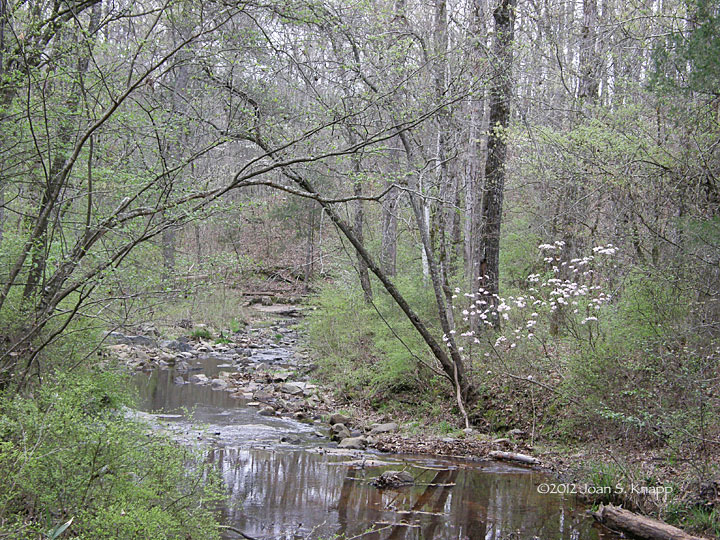
In late March 2012, looking…

upstream. There are rock bars across the creek with a gentle cascade of water over the south side.

Downstream. The water flows over a gravel bed until it cascades over small boulders and out of sight.

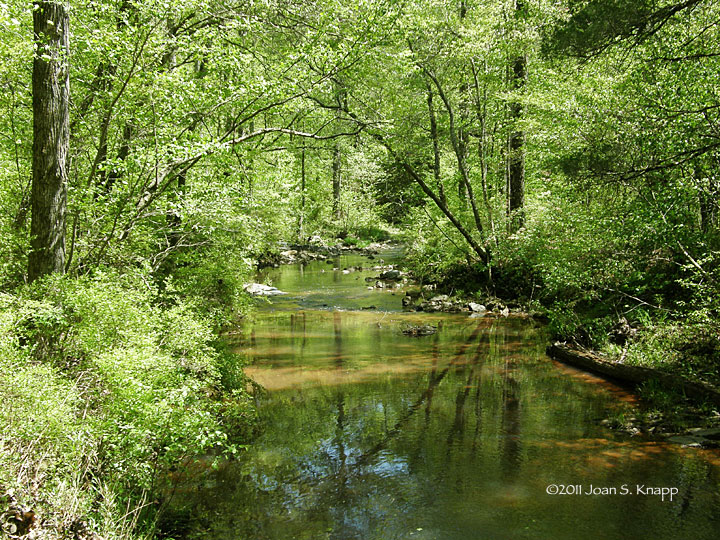
In late Spring - these images were taken in April 2012 - and through the Summer, the creek is bathed in rich green shade…

Upstream, and…

downstream.

As Fall approaches the flow in the stream slows and leaves accumulate on the surface.

Upstream. In late October 2011, the water was barely flowing, and

downstream, the gravel bed was exposed under the bridge.

Upstream in late October 2012, the creek bed was completely dry

A closer view.

Downstream, there was no water either.

Water flows again in December when the rains begin…

Upstream. In December 2011, the water, muddy from a recent rainfall, was flowing again, and

Cascading over the south end of the rock bar, and

Downstream if flowing freely again.

Upstream. In February 2013, the water, also muddy from recent rain, is flowing again.

Downstream.

The $64M question is whether the creek will dry up completely again this year.
Click on an image to view a larger image

Monday, February 4, 2013

What Is Wrong With These People?


February 2nd, 2013. A few weeks ago we went by eastern swamp on Enoch John Road in Wilkes County, Georgia.
This is what the swamp looked like in the summer of 2011. And a closer view of the…

American Lotus (Nelumbo lutea) in bloom.

The treasure was a beaver lodge in the open pond just above the beaver dam.


A closer views…

It was sunny on Saturday and we went back to Wilkes County to check on another creek but drove by the swamps.  Road work had been done on the west swamp on Anderson Mill Creek to channel the water from the rain we had last week. mini-dam was gone but this didn’t affect the beaver lodge at the east end of the swamp.

The sight that confronted us when we drove down the hill on Satruday was shocking…


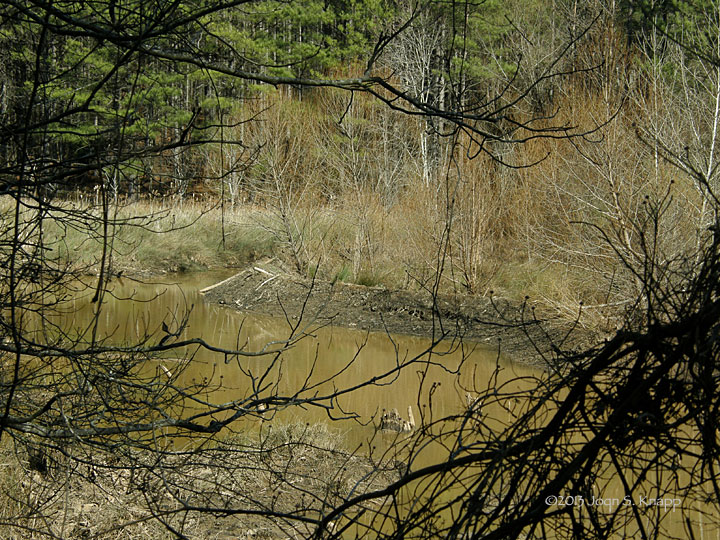
The swamp had been drained. The lodge was high and dry.

We walked along the ridge to the side of the swamp to get a better view of the lodge.

The western edge of the lodge was just above the water level of a channel through the swamp.

The back side of the dam at it’s highest point, and the…

area of water still behind the dam.

It didn’t take long to see where the dam had been breached…

The intact beaver dam near the road, photographed in December 2011, was intact when we saw it a few weeks ago, but now…


A section of the dam had been removed, leaving just a small streamlet draining through it. (the road is in the background).


A bulldozer had removed a section about six to seven feet long from the dam during the few days after the last rain judging by the freshness of the marks scoured into the side of the hole.

The destruection seems particularly wonton when the area has been in a relatively severe drought for a few years and the water impounded by this dam supports not only the beaver but other wildlife in the surrounding area. The dam was structurally sound and didn’t present any risk to the road just below it. Rather than destroying a large section of the dam down to its base, it would have made more sense to insert an overflow pipe into this section of the dam rather than destroy it completely. Hopefully, since this is prime real estate for beaver, they will repair the dam and return the swamp to its previous state.
Click on an image to view a larger image

Identification Resources:
University of Georgia Museum of Natural History: American Beaver (Castor canadensis) 

Related posts: