Sunday, August 2, 2015

Road Trip: Wilkes – McDuffie Counties, June 26th, 2015 (Part 2)


June 26th. (Continued from…). Once again, it was time for a road trip to monitor frogs. So, as usual, we used the trip to scout wildflowers.
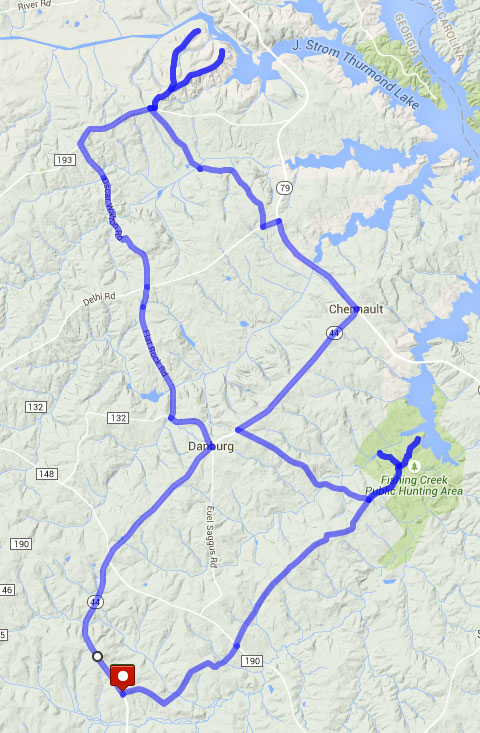
From Enoch John Road, we crossed Sandtown Road onto Jones Chapel Road, heading for the Fishing Creek Wildlife Management Area (WMA). Part way down the road, we were confronted with more than…


two dozen Variegated Fritillaries (Euptoieta claudia) ravenously feeding on Lanceleaf Coreopsis (Coreopsis lanceolata) flowers. These were the only flowers in sight and the fritillaries were making the best of them. They were moving so rapidly, I only managed this one shot.

The Fishing Creek WMA isn’t the greatest place for wildflowers but we can count on finding Clasping Milkweed (Asclepias amplexicaulis) in a couple of places. These plants are easy to identify, even when they are not in bloom; their…


leaves look leathery with undulating margins but the cardinal characteristic is how they ‘clasp’ around the stem. Several plants had…


developing seed follicles. This one was outstanding, with four follicles. 

We drove down to a point overlooking the Fishing Creek inlet to Clarks Hill Lake on the Savannah River, where…


Buttonbushes (Cephalanthus occidentalis) were blooming over the water. 

A small movement on the ground attracted my attention. It was a…


Small toad – about ½ to ¾ inches long. It hopped ahead of me and stayed in the shade, making photographing it challenging. It’s probably a Fowler’s Toad (Anaxyrus [Bufo] fowleri). It’s not the first time we’ve seen baby toads in this same spot.
We headed back out of the WMA and turned right on Ohara Standard Road, where we had found Narrowleaf Evening Primrose (Oenothera fructicosa) plants in bloom on our previous trip.

This time, some Butterfly Milkweed (Asclepias tuberosa) were still blooming. Being almost the only ‘game in town,’ they had attracted a…


Gray Hairstreak (Strymon melinus), and a…


Thread-waisted Wasp (Ammophila sp.), neither of which was discouraged by my presence. 

We headed over to the Broad River WMA via Bolton Road where we were tantalized by the sight of…


Clematis sp. seeds. Based on the flowering seasons of Clematis sp., these probably were one of the species with small, bell-shaped flowers. These may have been blooming on our previous trip but we overlooked them because they would blend into their background. We’re going to make a note to look for flowers earlier in the year now that we know precisely where to look for them. 


We still had plenty of sunlight left. We can’t start the frog survey until dark when the frogs start to call. So we decided to drive down GA-17 to Clarks Hill WMA. This is a better spot for wildflowers. At the right time of year, we’ve found Birdfoot Violets (Viola pedata), White Wild Indigo (Baptisia alba), and Indian Pink (Spigella marilandica). The roadside is mowed and the edge of this zone is often the best plat to find wildflowers. 

At the end of one road, we found…


Pigeonwings (Clitoria mariana), and a…


Spiked Hoarypea (Tephrosia spicata). 

At the edge of the woods, we saw a…


tree that had been thoroughly worked over by woodpeckers. 

Right at the edge of the mowed area, we spotted a lone…


Rosepink (Sabatia angularis) plant in...


bloom. It would have been easy to miss this in the late afternoon sun. 

We found one of the gates that is usually closed was open so we took the opportunity to drive through and we made our final spotting of the day.


From a distance, the plants did look like much, but there were a lot of them. When I walked over to them, I could see the similarity of the…


flower heads to the Hoary Mountainmint (Pycnanthemum incanum).


The leaves, however, were quite narrow compared with the Hoary Mountainmint. A little bit of research revealed that this was the Narrowleaf Mountainmint (Pycnanthemum tenuifolium).


Close-up views of the flowers. 

Once again, we had a successful trip meeting old friends, encountering some mysteries, and making at least one new friend.

Related posts:

Saturday, August 1, 2015

Road Trip: Wilkes – McDuffie Counties, June 26th, 2015 (Part 1)

June 26th. Once again, it was time for a road trip to monitor frogs. So, as usual, we used the trip to scout wildflowers.
We started the trip at the west end of Enoch John Road. On the section of road between Danburg Road and Anderson Mill Creek, I think I spent more time at the edge of, straddling, or in roadside ditches while photographing flowers.

There were the ‘usual suspects,’…


Lanceleaf Coreopsis (Coreopsis lanceolata),…


Starry Rosinweed (Silphium astericus),…


Hairy Angelica (Angelica venenosa), and


Heal-all (Prunella vulgaris).


A wild petunia, that I expected would be the Carolina Wild Petunia (Ruellia caroliniensis), turned out to be the Stalked Wild Petunia (Ruellia pedunculata); a nice surprise.

At the Anderson Mill Swamp, I found a…


Passionfruit (Passiflora incarnata) in bloom.


I was hoping that the Broadleaf Arrowhead (Sagittaria latifolia) would be in bloom, but alas not. 


A Zebra Swallowtail (Protographium marcellus) teased me for some time, flying back and forth along the road. 


From the Anderson Mill Creek swamp, we drove east to the swamp on the unnamed tributary to Fishing Creek.


The dam, repaired by the beaver, was holding. The large ‘bed’ of…


American Lotus (Nelumbo luteo) was thriving. We satisfied ourselves with admiring the…


flowers from the road. 


A small skipper, a Least Skipper (Ancyloxypha numitor), feeding on a


Bull Thistle (Cirsium vulgare). 


Then I noticed the…


leaves, and then the…


flowers of an Angularfruit Milkvine (Matelea gonocarpos). 


Then, on the other side of the road, I found another vine, climbing up a blackberry cane that had a…


Blackberry Knot Gall. This vine had even…


more flowers. 

(To be continued…)

Thursday, July 30, 2015

Caterpillar: Morning-glory Prominent / False Unicorn (Schizura ipomoeae)


June 26th. I was looking at our ornamental witch hazel (Hamamelis sp.) when I noticed what looked like the dead edge of a leaf. When I looked closer, I found this…


beautiful leaf-mimic caterpillar. 

This caterpillar was approximately 1.5 inches long. The first thoracic segment was brown as were the abdominal segments; the 2nd and 3rd thoracic segments were green. Intricate markings on both the green and brown segments enhance its beauty. It had fine setae (hairs) on the thoracic and abdominal segments; I didn’t see these until I processed the image.


This caterpillar had two prominent red pegs on the 1st abdominal segment and smaller pegs on the 4th, 5th, and 8th abdominal segments. 

I identified this caterpillar as the larva of the Morning-glory Prominent Moth (Schizura ipomoeae). This caterpillar is also known as the False Unicorn caterpillar.

The genus Schizura has nine species; five of these have green/brown coloration. Two species – S. unicornis (the larva of the Unicorn Caterpillar Moth) and S. ipomoeae – have similar color patterns. S. unicornis has head stripes and a humped A5 (fifth abdominal segment) as well as a white V-shape over A6 and A7 which distinguish it from S. impomoeae.

This caterpillar may be found from May to October throughout the United States and southern Canada. It feeds on the leaves of various woody plants, including beech (Fagus sp.), birch (Betula sp.), elm (Ulnus sp.), maple (Acer sp.), morning-glories (Ipomoea sp.), oak (Quercus sp.), and roses (Rosa sp.).  Interestingly, witch hazels (Hamamelis sp.) are not on this list. Add this genus to the list.

Reference:
 

Sunday, July 26, 2015

Canada Geese: Flotillas


June 24th. I was at Fort Yargo State Park, starting on my walk from the Section B to the Dam. I was crossing the bridge from the parking lot when I noticed some Canada Geese (Branta canadensis) swimming from an inlet on the west side of the bridge.


They were in considerable disarray when I first saw them. It took a minute or so to realize that there were two families. The goslings of one family were older than those in the other family; their white face patches were much more obvious since the feathers on their necks were darker. The younger goslings didn’t appear to have the face patches; they actually had face patches but their neck feathers were a lighter brown so that their was less contrast between them.


They were swimming towards the bridge. They started to separate into their respective families.


The ‘older’ family with the older goslings, and the…


‘younger’ family with the younger goslings; the younger family seemed more organized than the older family.


They all finally got themselves organized into separate families and approached the bridge in almost straight lines.


As the older family emerged on the east side of the bridge, they were in disarray again. In contrast, the…


Younger family were still somewhat organized and it was a while before they spread out.

I was a little amused. It looked like the older goslings were more independent and, while they were willing to approach the bridge in single file under their parent’s guidance, they were beginning to assert their independence compared with the younger goslings that still needed their parents guidance.