Thursday, October 14, 2010

Turning Green While You Wait

I heard a scrambling at the base of a tree beside the trail south from the Fishing area (segment 13) and turned around expecting to see an Eastern Fence lizard (Sceloporus undulates) or a Five Lined Skink (Eumeces sp). Not a Green Anole. But there it was. This was the first time I’d ever seen a Green Anole (Anolis carolinensis) at Fort Yargo State Park.


In the early morning, the temperature was still cool and the anole was quite brown. It had crawled up into the sunlight on the tree trunk to catch some rays.

Within a minute, it started to turn green. I waited for several minutes in the hope that it would turn completely green but it was still to cool and it stayed the same color. So I had to move on.

Click on an image to view a larger image


Identification resources:

- Savannah River Ecology Laboratory: Green Anole (Anolis carolinensis)

Wednesday, October 13, 2010

The Sap Tree

I don’t even know what kind of tree it was. But as I made my way from the parking lot down to the lake shore (segment 12) I noticed that a number of insects and butterflies gathered at the base of the tree. Only this tree among all the others along the bank.

There was a large black area at the base of the tree.

A closer view.

At first I thought a mushroom had ‘decomposed’ to leave a black patch which has been common in the woods this Fall. However, the tree appeared to be oozing sap and quite a diverse variety of creatures were puddling. A Red Admiral (Vanessa atalanta) and an Eastern Comma (Polygonia comma) stopped by for a few seconds but didn’t settle.

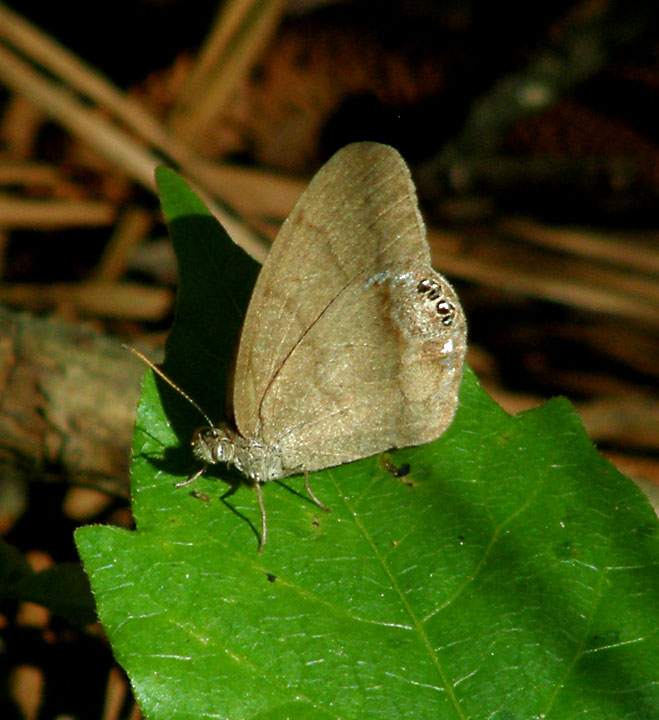
A Gemmed Satyr (Cyllopsis gemma)


Sharing the same space with an ant

At first I thought it was a cicada skeleton but a close look revealed it was a beetle. I don’t know what it is. I don’t know if it was alive or not. It looks like it’s cemented in. And it was sharing space with an Eastern Yellowjacket.

The Eastern Yellowjacket (Vespula maculifrons) was dwarfed by a European Hornet (Vespa crabro).

And a closer view of the European Hornet. I’d seen a few of these along the trail over the last few weeks but they were twitchy and flew away as I approached. This one was posing.

I usually go down to the lakeshore by a different route. I’m not sure why I went this way on this day but this was a serendipitous find.


Postscripts:
I checked the tree a week later
1. It's an oak.
2. The sap had stopped oozing.
3. The beetle had disappeared so I guess it was alive and not permanently 'glued' into the crevice.
Click on an image to view a larger image


Identification resources:

- Butterflies and Moths of North America: Gemmed Satyr (Cyllopsis gemma)

- BugGuide: Eastern Yellowjacket (Vespula maculifrons)

- BugGuide: European Hornet (Vespa crabro)

Tuesday, October 12, 2010

Gemmed Satyr (Cyllopsis gemma)

The Gemmed Satyr (Cyllopsis gemma) is considered uncommon in this area and, certainly, it’s uncommon compared with the Carolina Satyr (Hermeuptychia sosybius) which is very common in the area. I saw one at home in 2009 but I’ve seen two this year at Fort Yargo State Park. It’s a little gem of a butterfly and a treat to see.

This one was resting on a leaf by a trail in the woods not far from the dam in May.

This only was puddling at the base of a tree by the parking lot at the Fishing Area (segment 12) last Sunday.

Click on an image to view a larger image


Identification resources:

- Westcentral Georgia Butterflies by Michael Beohm: Gemmed Satyr (Cyllopsis gemma)

-
BugGuide: Gemmed Satyr (Cyllopsis gemma)
-
Butterflies and Moths of North America: Gemmed Satyr (Cyllopsis gemma)

Related post:
- Carolina Satyr (Hermeuptychia sosybius)

Monday, October 11, 2010

Steady… Steady… Gotcha!

Last Friday, I saw a Great Egret on the lake at Fort Yargo State Park. I’d rowed into the bay by the Old Fort (segment 11) and saw one fishing near the bridge over the road where Upper Marburg Creek drains into the lake. It was a long shot but I thought I’d see if I could get closer to get a photo. I was surprised that I could get relatively close but the bird was concentrating so intently on fishing that it ignored me. I swung around to face it and got the following photos

Steady…
The bird was surveying the water in front of it.

Steady…
It spotted something of interest.

Gotcha!
It'd just tossed its head back to let gravity carry the fish down into its gullet. Nice catch!

Note: It’s interesting to see a Great Egret on the lake at this time of year. I’ve been rowing here for nine years and, previously I’ve only seen Great Egrets on the lake earlier in the year during a drought year. Usually I only see Great Blue Herons (Ardea herodias); usually three or four at this time of year; this year I’ve only seen one. I did catch a glimpse of a Green Heron (Butorides virescens) and only on one occasion a few weeks ago. I wonder if the strange weather this year has altered the behavior of all of these birds.

Click on an image to view a larger image


Identification resources:

- The Cornell Institute of Ornithology: Great Egret (Ardea alba)

Related post:
- Great Blue Heron (Ardea herodias)

Sunday, October 10, 2010

Checkered-Skipper: Common (Pyrgus communis) or White (Pyrgus albescens)

We took a field trip to Oconee and Greene counties yesterday. We stopped in north Greene county to photograph sunflowers. After a few minutes, several white and brown spread-winged skippers appeared and worked the flowers. They were frenetic. They’d spend a few seconds working a flower and then move on to another. In spite of this, I managed to get a few shots.

These are Common Checkered-Skippers (Pyrgus communis) or White Checkered-Skippers (Pyrgus albescens). There is a debate that Pyrgus albescens has displaced Pyrgus communis in this area. However, the only way to differentiate between these species is to examine the sexual organs of the males. So I have to settle for a split identification. These guys were hardly hanging around for a photograph let alone a physical examination.


I've only seen one similar butterfly previously but was unable to photograph it. It was in Walton County and had much more white than this one.

Click on an image to view a larger image


Identification resources.
Westcentral Georgia Butterflies by Michael Beohm: Common/White Checkered-Skipper (Pyrgus communis/Pyrgus albescens)


BugGuide:

- Common Checkered-Skipper (Pyrgus communis)

- White Checkered-Skipper (Pyrgus albescens)


Butterflies and Moths of North America:

- Common Checkered-Skipper (Pyrgus communis)

- White Checkered-Skipper (Pyrgus albescens)


Butterflies of the Carolinas and Virginias
- Common Checkered-Skipper (Pyrgus communis)

- White Checkered-Skipper (Pyrgus albescens)

Saturday, October 9, 2010

Littleleaf Sensitive-briar (Mimosa microphylla)

Mimosa microphylla is known by the common names Littleleaf Sensitive-briar, Eastern Sensitive-briar, Sensitive Briar. This plant grows more as a ground cover in north Georgia; I've seen it in Walton, Barrow and Wilkes counties. At Fort Yargo State Park it grows along the lake shore near the Wil-A-Way Recreation Center (segment 9), south of the Fishing Area on the cliff by the slip-rail fence (segment 13), and east of the swimming beach (segment 14). This plant begins to bloom in mid June.

A plant growing on the shoreline at Fort Yargo State Park (segment 9).

A closer view.

Growing along the roadside in Walton County; this is one of the largest areas covered by Mimosa microphylla in the area.

*****
Close up views of the bloom.

*****
The leaves before and after being touched.

Seed pods developing.

A close up of a developing seed pod; these are very spiny.

A ‘ripe’ seed pod that has split longitudinally and dispersed its seeds.

A seed pod that still contains seeds.

A close up showing the seeds.

Mimosa microphylla
(Littleleaf Sensitive-briar) is native to the United States. It grows from Virginia, Kentucky and Illinois south to Mississippi and .Florida; it also grows in Louisiana and Texas.

Click on an image to view a larger image


Distribution Map:

- United States Department of Agriculture Plants Database: Mimosa microphylla (Littleleaf Sensitive-briar)

- University of North Carolina Herbarium: Mimosa microphylla


Identification resources:

- Southeastern Flora: Littleleaf Sensitive-briar (Mimosa microphylla)

- Natural and Naturalized Plants of the Carolinas and Georgia: Mimosa microphylla (Eastern Sensitive-briar)

- Alabama Plants: Mimosa microphylla (Sensitive Briar)


Related posts:

- 2010: Year Of The Wildflower – Wildflower Index

Friday, October 8, 2010

Fort Yargo State Park: Early Fall Color

The Blackgums (Nyssa sylvatica) have been hinting at changing color for a few weeks; just a tinge of color. But today the color change is definite. But this may be a strange year for color at the lake. After an extremely hot spring and summer and an unusual rain pattern, I don’t think the color changes will be as dramatic as they have been over the last two years. I noticed a few trees whole leaves normally turn yellow had lost most leaves. But time will tell…

The color along segment 4. Most are Blackgums.

This one, an oak, is unusual, Usually oaks are among the last to change color.

Another tree changing color along the Bird Berry Trail (segment 10a). Interestingly the Alligator Weed (Alternanthera philoxeroides) rafts have broken up and I could row further into segment 10 than previously.

Looking north towards the Fishing Area and my favorite Blackgum to the left of the bridge (segment 13).

A closer view of that Blackgum. It doesn’t look as good up close. It wasn’t as densely leaved as usual this year possibly due to the weather. It’s an old tree; it wasn’t a young tree when I first saw it 25 years ago. It may also be suffering more severely from the partial ringbarking it had been subjected and which was already healed when I first saw it.

A bit of an anomaly among the trees ‘closing down’ for the year. This Sourwood (Oxydendrum arboreum) is still blooming as were several others along this segment (13).

A smaller Blackgum is glistening red among the green pines (segment 13).


It will be interesting to follow the color changes as time goes on.
Click on an image to view a larger image


Related posts:

- Loose with a Camera…

- First Fall Row