Tuesday, March 11, 2014

At The Feeders: Ruby-crowned Kinglet (Regulus calendula)


March 11th, 2014. We installed a couple of log feeders in mid-December, 2013. Our inspiration came from a log feeder at the Ontario FeederWatch Cam sponsored by the Cornell Lab of Ornithology that was visited regularly by a Pileated Woodpecker (Dryocopus pileatus). 
Within a day or so of installation, Downy Woodpeckers (Picoides pubescens) began to feed at these logs and, within a few days, other birds began to investigate the logs.

As with the Hermit Thrush, I was delighted when I spotted a Ruby-crowned Kinglet (Regulus calendula). I didn’t expect to see a kinglet at all. 

When I first noticed it, it was foraging around in the leaves near the feeders…

but then noticed that it was also spending time at the log feeders. Sometimes it can perch and feed. At other times… 

it hovers and grabs a mouthful ‘to go.’ Then… 

it flies to a nearby branch to eat. 

Occasionally, it will feed at a suet cake attached to the platform feeder. 

I wasn’t convinced that it was a kinglet until I’d seen its red crest. Mostly, I've only seen the crest fully extended just after a kinglet has landed. I’ve only been able to photograph the ‘remnant’ of the red crest is retracted soon after it has landed.

The kinglet is hard to photograph. It flits from branch to branch continuously. It visits the log feeders repeatedly from early morning to late afternoon. Although it spent some time foraging near the feeders during the cold weather, it is spending most of its time at the log feeders now. 

Identification resource:

Related posts:   

Wednesday, March 5, 2014

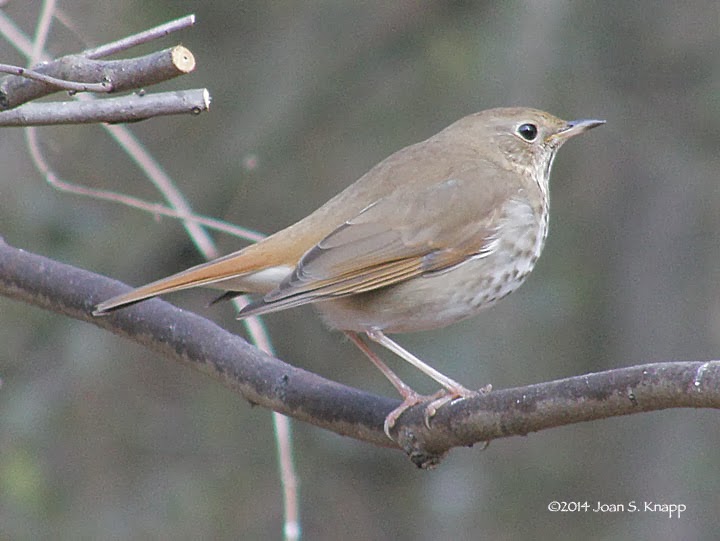
At The Feeders: Hermit Thrush (Catharus guttatus)

March 5th, 2014. We installed a couple of log feeders in mid-December, 2013. Our inspiration came from a log feeder at the Ontario FeederWatch Cam sponsored by the Cornell Lab of Ornithology that was visited regularly by a Pileated Woodpecker (Dryocopus pileatus).  

Within a day or so of installation, Downy Woodpeckers (Picoides pubescens) began to feed at these logs and, within a few days, other birds began to investigate the logs. 

I was delighted when I spotted a Hermit Thrush (Catharus guttatus) on a limb near the log feeders. I didn’t expect to see a thrush at the feeders. 

Luckily it chose this limb as its usual perch, and landed on… 

a couple of other ‘open’ limbs after grabbing food from the logs. 

The thrush wasn’t particularly adept at landing on the log to feed and would grab a mouthful of food ‘to go.’ 

On very rare occasions, it would gain purchase on the feeder but still have to flap its wings to stay in place. 

Occasionally it would forage for the seed mixture that had fallen on the ground. 

The Hermit Thrust would visit the log feeders intermittently from early morning to late afternoon.

Identification resource: 

Related posts:  

Tuesday, March 4, 2014

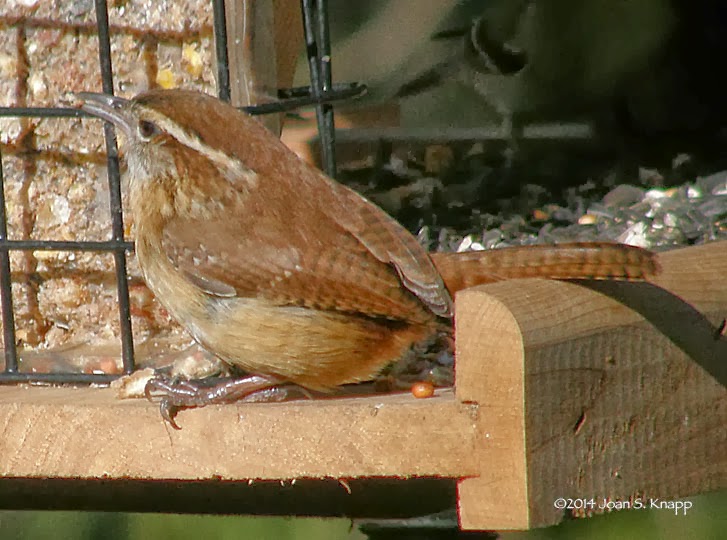
At The Feeders: Carolina Wren (Thryothorus ludovicianus)


March 4th, 2014. We installed a couple of log feeders in mid-December, 2013. Our inspiration came from a log feeder at the Ontario FeederWatch Cam sponsored by the Cornell Lab of Ornithology that was visited regularly by a Pileated Woodpecker (Dryocopus pileatus).  

Within a day or so of installation, Downy Woodpeckers (Picoides pubescens) began to feed at these logs and, within a few days, other birds began to investigate the logs. Carolina Wrens (Thryothorus ludovicianus) are regular visitors to these logs. 

Occasionally we can see Carolina Wrens foraging on the ground. 

A wren, about to fly up to one of the log feeders. 

On the log feeder,… 

feeding. 


They also feed at the suet block attached to the platform feeder.

Carolina Wrens arrive at the feeders soon after light and feed on-and-off throughout the day until dusk. 
 
These wrens are also fascinating because they will build nests and raise their young in close proximity to us.  Among they places they have build nests include the paper box by the road, on a drill press, under the cover on the top of an outboard motor, in a hanging plant, in boxes of screws and bolts, and in a camper. Wonder where they will nest this year?
 
Identification resource: 

Related posts:   
Saturday, March 1, 2014

At The Feeders: Yellow-rumped Warbler (Setophaga coronata/Dendroica coronata*)

March 1st, 2014. We installed a couple of log feeders in mid-December, 2013. Our inspiration came from a log feeder at the Ontario FeederWatch Cam sponsored by the Cornell Lab of Ornithology that was visited regularly by a Pileated Woodpecker (Dryocopus pileatus).

 Within a day or so of installation, Downy Woodpeckers (Picoides pubescens) began to feed at our logs and, within a few days, other birds began to investigate the logs. Among these were Yellow-rumped Warblers (Setophaga coronata).  

At first I didn’t recognize it until I saw it hovering at a log feeder where it displayed its tell-tale yellow rump. At first, we only saw one warbler at the feeders at any one time until mid-February when two, and then three warblers would be present at the same time. 

Views of warblers perched near the feeders.

Sometimes, none of the yellow is showing,…

When yellow is visible, it’s usually the yellow under the front of the wing.

Occasionally, the yellow rump is partially visible, and…
 
On even rarer occasions, both the yellow under the wing and on the rump are visible when the birds are feeding on the log.
 
This little guy was up early one morning as posed in an unusual spot.

Rarely, they will visit the platform feeder to sample the suet mix.

They will feed peacefully at the logs with other bird species , in this case Downy Woodpeckers, and...

Pine Warblers (xx) among others, but...
 
haven’t been tolerant of other Yellow-rumped Warblers.  They will chase other warblers away.

The Yellow-rumped Warblers arrive at the feeds soon after light and are among the last birds to leave in the evening. 

Iidentificaiton resources:
- Integrated Taxonomy Information System: Yellow-rumped Warbler(Dendroica coronata*) 

Related posts: