Note: Bernard Brown at Philly Herping has kindly corrected my identification. Please see his comment below which provides excellent characteristics to differentiate between the Eastern Kingsnake and the Black Rat Snake. Thanks Bernard. I've included links to both the Rat snake - this link shows the Black, Gray, and Yellow Rat snakes - and the Eastern Kingsnake so that you can compare photos of these snakes. Luckily, the snake, correctly identified, was still nonvenomous; neither it nor I came to any harm.
Meanwhile, visit House of Herps #7 to read about other herp adventures.
We don’t see many snakes these days – not even as road kill. I’ve been keeping my eyes open for snakes this year. It was mid afternoon; about 3:20 pm on a Friday afternoon. I’d stopped along the trail just after it left the dam (segment 4) to rest. A couple of runners came by. I set off again and wasn’t really paying attention. I came around a turn in the trail that was obscured by a tree. And there it was… A Black Rat Snake (Pantherophis obsoleta); a non-venomous snake found throughout Georgia.
 Obviously I startled it; even from a distance, you can see the ripples of the tensed muscles in its body. It was a blessing that it froze since I was startled as well. Luckily I was walking, not running – the encounter might have been quite different if I’d been running. My major concern at that moment, however, was whether my camera was ready. Since this section of trail doesn’t offer a lot of photo ops I wasn’t paying attention to camera settings. So the fact that it froze allowed me to get these photos.
 I edged slowly off to the left so that it could make a break for it if it wanted to. But it stayed in the same place.
You can see the its white belly and the patchy white scale pattern on its back.
 A close up of its head.
 Please may I go? By this time, it wanted to leave. It made a move but was still concerned by my presence.
 It’s leaving. It was only when it started to leave that it began probing the air with its tongue. It also ‘rattled’ its tail silently, kicking up a small dust cloud as it moved along. It headed off down the slope towards the lake shore, probably to get a drink.
Click on an image to view a larger image
Identification resources:
Snakes of Georgia and South Carolina
- Black Rat Snake (Pantherophis obsoleta)
- Eastern Kingsnake (Lampropeltis getula)
Paulownia tomentosa is known by the common names Princess Tree, Princesstree, Foxglove Tree, Royal Paulownia Tree, or Empress Tree. It's a tree that grows to 50 to 75 feet high. The tree begins to flower before the leaves develop.
This is the only tree that I’ve seen naturally occurring; I've seen others, but not many, in cultivated gardens. This tree is on the south side of Marburg Creek, just below the dam in Fort Yargo State Park. To reach it I walked down the back side of the dam to the bike trail and then directly across to the tree. This area is a seep from the ledge above to the creek and was covered by a couple of inches of water. When I left, I walked directly back to the ledge and across to the bike trail. This would have been a better approach to reach the tree.
 The tree in bloom – photographed from the top of the dam
 A cluster of flowers
 Close up of an individual flower.
 Seed pods left from last year.
Paulownia tomentosa (Princess Tree) is native to western and central China. In the United States, its range extends from New York-Connecticut in line across the country to Texas and south to Florida.
Click on an image to view a larger image
Distribution Map:
- United States Department of Agriculture Plants Database: Paulownia tomentosa (Princesstree)
- University of North Carolina Herbarium: Paulownia tomentosa
Identification resources:
- Southeastern Flora: Princess Tree (Paulownia tomentosa)
- Native & Naturalized Plants of the Carolinas and Georgia: Paulownia tomentosa (Princess Tree, Royal Paulownia, Empress Tree)
- Wikipedia: Paulownia tomentosa
Related posts:
- 2010: Year Of The Wildflower
Sisyrinchium mucronatum is known by the common name Needle-tip Blue-eyed-grass. This species is one of several Sisyrinchium species that may be found in Georgia. The flower petals of this species are of equal width to the tip at which they decrease quite acutely and extend in a needle-like tip. Similar to Sisyrinchium rosulatum, Sisyrinchium mucronatum flowers are approximately 1/2 inch across, and blend into the background until you’re almost on top of them. In contrast to Sisyrinchium rosulatum whose highlight color is purple, Sisyrinchium mucronatum flowers are clearly blue.
In Fort Yargo State Park, I’ve seen Sisyrinchium mucronatum at in an open area and a shaded area midway along segment 13. I’ve seen these flowers at home: in the open by the creek and along the drive as well as in the woods where they grow in complete shade. Flowers in the grass in an open area midway along segment 13 in Fort Yargo State Park
 A little closer
 Up close. This photograph shows the needle-tipped shape of the petals and the blue color; compare with Sisyrinchium rosulatum
 This photograph is of a flower growing in complete shade. It shows the grass-like leaf and a developing seedpod immediately to the left of the flower.
Sisyrinchium mucronatum (Needle-tip blue-eyed-grass) is found in the eastern United States and Canada from Saskatchewan to Quebec, but not the maritime provinces, and in an arc from North Dakota, Minnesota, Wisconsin and south to Illinois, Tennessee, Mississippi, and Louisiana. It is found in all states east of this line with the exception of Indiana, Kentucky and Florida.
Click on an image to view a larger image
Distribution Map:
United States Department of Agriculture Plants Database:
- Sisyrinchium rosulatum (Annual blue-eyed grass)
- Sisyrinchium mucronatum (Needle-tip blue-eyed-grass)
University of North Carolina Herbarium:
- Sisyrinchium mucronatum (Blue-eyed Grass)
- Sisyrinchium rosulatum (Annual Blue-eyed Grass, Lawn Blue-eyed Grass)
Identification resources:
Southeastern Flora:
- Needle-tip Blue-eyed-grass (Sisyrinchium mucronatum)
- Annual blue-eyed grass (Sisyrinchium rosulatum)
Alabama Plants: Sisyrinchium rosulatum
Related posts:
- 2010: Year Of The Wildflower
- Annual blue-eyed grass (Sisyrinchium rosulatum)
Sisyrinchium rosulatum is known by the common names, Annual Blue-eyed Grass, or Lawn Blue-eyed Grass). This species is one of several Sisyrinchium species that may be found in Georgia
I’ve seen Sisyrinchium rosulatum at several places in Fort Yargo State Park: on the point in the Fishing Area, in the grass near the Old Fort, and along the roadside to the campground. In each case, I almost stepped on the flowers before I saw them. They are small flowers, about 1/2 inch across, and blend into the background until you’re almost on top of them. I’ve not seen them in Walton County but that could because one would have to walk an area to see them.
 Putting the flower size in perspective. The foliage is grass-like, as the name implies so that, so the plant doesn’t stand out against the grass. Don't see it? It's right in the middle of the photo.
 A little closer. This is a particularly thick cluster of plants. I found most flowers as individual flowers or clusters of two or three.
 Up close. Sisyrinchium rosulatum flowers are purplish rather than blue. This photograph also shows the broad grass-like leaf.
 Up close, in profile.
Sisyrinchium rosulatum (Annual Blue-eyed Grass) is found in the coastal states in the southeastern United States from North Carolina to Texas.
Click on an image to view a larger image
Distribution Map:
United States Department of Agriculture Plants Database:
- Sisyrinchium rosulatum (Annual blue-eyed grass)
- Sisyrinchium mucronatum (Needle-tip blue-eyed-grass)
University of North Carolina Herbarium:
- Sisyrinchium rosulatum (Annual Blue-eyed Grass, Lawn Blue-eyed Grass)
- Sisyrinchium mucronatum (Blue-eyed Grass)
Identification resources: Southeastern Flora:
- Annual blue-eyed grass (Sisyrinchium rosulatum)
- Needle-tip blue-eyed-grass (Sisyrinchium mucronatum)
Alabama Plants:
- Sisyrinchium rosulatum
Native & Naturalized Plants of Georgia and the Carolinas: Sisyrinchium rosulatum (Annual Blue-eyed Grass, Lawn Blue-eyed Grass)
Related posts:
- 2010: Year Of The Wildflower
- Needle-tip blue-eyed-grass (Sisyrinchium mucronatum)
I’ve identified this shrub as Rhododendron austrinum (Orange Azalea, Florida Flame Azalea or Yellow Azalea) based on the color of the bloom and the morphology of the stamens. I know of only one shrub in Fort Yargo State Park and it is growing in an area not accessible from trails. It can be seen from the water (segment 9).
 The shrub in bud
 A bud, up close. In the background, leaves have emerged but are not fully developed.
 The shrub in flower – from out on the water.
 A little closer. The long, curved stamens are visible, even at a distance.
 A closer view of the flowers. The long, curved stamens are quite apparent.
 The fully developed leaves
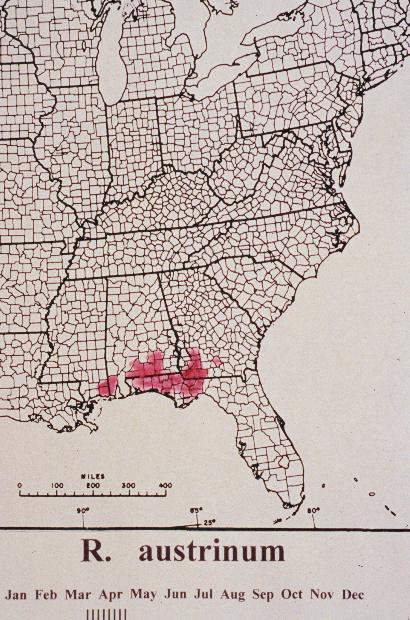
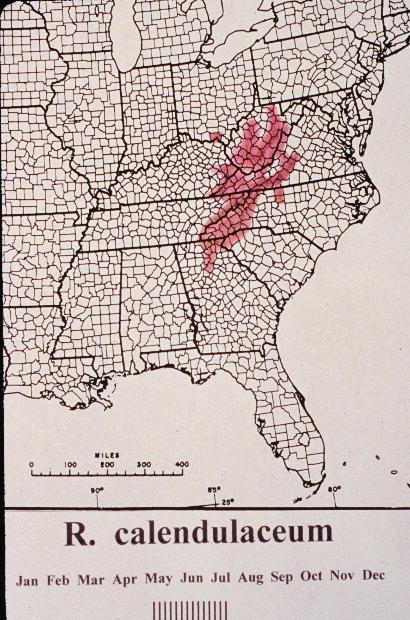
There are two orange azalea species that may occur naturally in Georgia. One species is Rhododendrum austrinum – the Orange Azalea or Florida Flame Azalea – which is found only in Florida, Georgia, Alabama, and Mississippi. The other species is Rhododendron calendulaceum – the Flame Azalea – which is found in the southeastern states from New York south to Mississippi and in all states east with the exception of Florida. More detailed maps indicate that Rhododendron calendulaceum is found more frequently in the Blue Ridge mountrains including counties in north Georgia and Rhododendron austrinum is found more frequently in the Gulf Coast counties in southern Mississippi, Alabama, Florida, and in southwestern Georgia counties (see Distribution Maps)
So the observation of this shrub in Fort Yargo State Park is a little south of the range for naturally occurring Rhododendron calendulaceum and north of the range for Rhododendron austrinum. However, the morphology of the stamens – long and curved is similar to Rhododendron austrinum rather than shorter and straighter than those of Rhododendron calendulaceum.
Click on an image to view a larger imageDistribution Maps:
United States Department of Agriculture Plants Database:
- Rhododendron austrinum (Orange Azalea)
- Rhododendron calendulaceum (Flame Azalea)
Identifying the East Coast Native Azaleas:
- Rhododendron austrinum (Florida Azalea)
- Rhododendron calendulaceum (Flame Azalea)
University of North Carolina Herbarium:
- Rhododendron austrinum
- Rhododendron calendulaceum
Identification resources:
Identifying the East Coast Native Azaleas: Orange to Red Group
- Rhododendron austrinum (Florida Azalea)
- Rhododendron calendulaceum (Flame Azalea)
Alabama Plants
- Rhododendron austrinum (Florida Flame Azalea)
- Rhododendron calendulaceum (Flame Azalea)
Native and Naturalized Plants of the Carolinas and Georgia:
- Rhododendron austrinum (Florida Azalea)
- Rhododendron calendulaceum (Flame Azalea)
Related posts:
- 2010: Year Of The Wildflower
- Pinxter Azalea (Rhododendron canescens)
 Crossvine occurs on only one area of the lake that I’m aware of – on segment 12 almost to the point at the junction of segments 11 and 12. There was a sand bar in the lee of the point when the lake level was lowered. I had gone out on it to photograph a Red-Spotted Purple (Limenitis arthemis) butterfly.
 When I turned around to go back up onto the trail, I noticed these fallen blooms.
 The flower – up close.
 The vine grows high up in an oak tree.
 A closer view of the flowers up in the tree.