Thursday, August 20, 2015

Summer On A Fort Yargo State Park Trail: Section B To The Dam, July 8th (Part 2)

July 8th. (Continued from…). When I visited Fort Yargo State Park in mid-February, there were few signs of Spring. The only wildflower plants that were obvious were the leaves of Cranefly Orchids (Tipularia discolor) that I found in many places.


The route… I’ve described it here, here, here, and here This walk doesn’t have the variety of wildflowers as my other walk from the Group A Shelter to the Old Fort but it does have some gems. One of the Smallflower Pawpaw (Asimina parviflora) had developed fruit that, unfortunately, it had lost; the Pink Lady’s Slipper (Cypripedium acaule) Orchids had bloomed, and some Green Adder’s-mouth (Malaxis unifolia) Orchids had bloomed and two were setting seeds. The occurrence of slime mold fruiting bodies added a new focus of interest for this walk.

Before I started back along the return trail, I wandered around the area at the west end of the dam.


A Winged Sumac (Rhus copallinum) was beginning to bloom. I didn’t know it was a Winged Sumac at the time. I’ve always been confused by sumacs but, it turns out, this one gives itself away. It has…


narrow wings - ‘strips’ of leaf-like tissue – along the stalk between the leaflets.


The Bigroot Morning Glory (Ipomoea pandurata) vine was still blooming in the shade at the edge of the woods.


My next stop was the Hairy Angelica (Angelica venenosa). Seed capsules were starting to develop but a little surprise was waiting for me, literally. A…


Swift Crab Spider (Mecaphesa celer) was hunting on the top of the flower head. Many adult Swift Crab spiders are brightly colored but immature spiders are almost colorless. This spider was still mostly colorless.

I didn’t see this spider at first; it was perfectly camouflaged for the location it had chosen to hunt. Interestingly, among the many genera in the Crab Spider family Thomisidae, there are three genera – Misumena, Misumenoides, and Mecaphesa – that we find hunting on flowers. Spiders in these genera may be differentiated by the arrangement of the eyes; mecaphesas are also hairy.


My favorite tree was bathed in sunlight.


A couple of bright red mushroom caught my attention. They looked like they had been coated in red varnish. I guessed they were boletes – mushrooms that have pores instead of gills. There were several in the area, so I turned one over to take a closer look. Its …


pore surface was bright red and the stem had coarse reticulations. This was a very striking mushroom and it was relatively easy to identify as Frost’s Bolete (Boletus frostii).


The seed capsules were still developing on the New Jersey Tea (Ceanothus americanus).


The Oak Apple Gall had a tiny hole in it.


The Green Arrow Arum (Peltandra virginica) fruit were still healthy.


A log lying across a small gully at the lake’s edge was covered with mushrooms; their caps were about an inch in diameter. These fit the description of Fuzzy Foot (Xeromphalina campanella) mushrooms but I couldn’t get close to them.


Bicolor Lezpedeza (Lespedeza bicolor) bushes were still blooming. These bushes grow in an area that gets sun until early afternoon.


I found more ‘Honeycomb’ Coral Slime (Ceratiomyxa fruticulosa var. porioides) fruiting bodies on an old rotting log by the trail on the north section of the trail.


The seed capsules were still developing on the Perfoliate Bellwort (Uvularia perfoliata) plant. 

A little way off the trail, I found a…


Dog Vomit (Fuligo septica) slime mold fruiting body that was a pale green.


Another lone Hairy Elephantsfoot (Elephantopus tomentosus) was blooming by the trail.


I found this cluster of pretty mushrooms growing at the base of a hardwood tree. I didn’t want to disturb this cluster so I turned over a…


smaller mushroom. The cap was convex when the mushroom was young but later inverted into a vase shape; the gills started to run down the stem and there was some evidence of cross gills. At this time, I haven’t been able to identify it.


The seed capsules on the Green Adder’s Mouth Orchids (Malaxis unifolia) were still developing. 

I made my way up to the top of ‘The Hill’ in the hope that I might find some more slime mold fruiting bodies. I wasn’t disappointed.


I found Chocolate Tube (Stemonitis sp.) slime mold fruiting bodies on one end of a log. These had formed…


very recently; the tubes…


hadn’t had time to separate. These were the nicest fruiting bodies I’d seen to date. 

On another log, I found the…


Many-headed slime mold (Physarum polycephalum) forming fruiting bodies.


A closer view. This was the first time I had seen this slime mold.


Another Dog Vomit fruiting body had formed on yet another log. Some of the plasmodium had settled on a pine needle and formed a…

‘Q-tip.') 

From the Hill, I walked back to the open area. I spotted a…


Sleepy Orange (Abaeis nicippe) butterfly.


Brazilian Vervain (Verbena brasiliensis) had been flowering along the open section of trail for some time. On the other hand…


Spotted St. John’s Wort (Hypericum punctatum) flowers for a relatively short time along the final section of the trail. 

Related posts:  
- Spring Is In The Air: Fort Yargo State Park, Section B To The Dam, May 1st (Part 2)

Wednesday, August 19, 2015

Summer On A Fort Yargo State Park Trail: Section B To The Dam, July 8th (Part 1)


July 8th. When I visited Fort Yargo State Park in mid-February, there were few signs of Spring. The only wildflower plants that were obvious were the leaves of Cranefly Orchids (Tipularia discolor) that I found in many places.


The route… I’ve described it here, here, here, and here This walk doesn’t have the variety of wildflowers as my other walk from the Group A Shelter to the Old Fort but it does have some gems. One of the Smallflower (Asimina parviflora) had developed fruit that, unfortunately, it had lost; the Pink Lady’s Slipper (Cypripedium acaule) Orchids had bloomed, and some Green Adder’s-mouth (Malaxis unifolia) Orchids had bloomed and two were setting seeds. The occurrence of slime mold fruiting bodies added a new focus of interest for this walk. 

I found a few of the ‘usual suspects’ on the trail in the main woods.


The Witch’s Butter (Tremella mesenterica) was growing again after recent rains.


The Bicolor Lespedeza (Lespedeza bicolor) bushes were still blooming; the flowers seemed a little deeper pink than the earlier ones.


A Starry Rosinweed (Silphium astericus) was still blooming in the woods; and still had buds waiting in the wings. 

I stopped by the first log. I found a  some Wolf’s Milk (Lycogala epidendrum) fruiting bodies in a ‘bed’ of slime mold fruiting bodies that looked like…


Coral slime (Ceratiomyxa fruticulosa var. fruticulosa) that has just simple sporangia.


Closer examination, when I processed the images. showed that these were mature fruiting bodies of Ceratiomyxa fruticulosa var porioides. This slime mold has ‘honeycomb-shaped’ fruiting bodies compared with the simple ‘single-stalk’ fruiting bodies of the fruticulosa variety. It’s easier to see this structure in the developing image here.


Then I found some more fruiting bodies of what is probably Arcyria cinerea. And more Chocolate Tube (Stemonitis sp.) fruiting bodies, both…

recently formed, and…


a bit the worse for wear, and even some more that were…


hanging upside down ‘under’ the log. The pull of gravity had caused the spores to ‘clump’ which made the sporangium look somewhat segmented. 

Then I found…


these small black shiny fruiting bodies, less than a millimeter tall. The dull bodies are the same as the shiny ones. The shiny ‘crust’ has broken to allow the spores to be released. Believe it or not, these fruiting bodies are on tiny stalks. 

Among the tiny black fruiting bodies, I found these…


white fruiting bodies. There were a few individuals, but most seemed to occur as…


clusters of four or more. I don’t know what these are either. They were, perhaps, a millimeter tall. 

The last slime mold I found on the log was…


this one. I almost missed these. They were so small; perhaps a millimeter tall but with very tiny tan-colored sporangia sitting on top of very slender brown stalks. The look bigger in the photo than they were.


I finally left the first log and walked past the Turkey Tail (Trametes versicolor) bracket fungi and up ‘The Hill’ to the second log. 

At the second log, I was in for another surprise. I found a small patch of the fungus that I have tentatively identified as the…


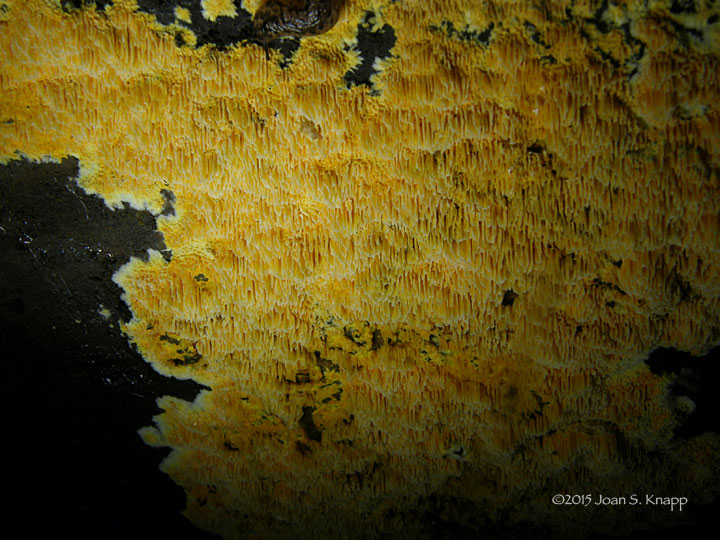
Orange Sponge Polypore (Pycnoporellus alboluteus). This patch was only seven to eight inches long but I was glad to see it. This means the fungus is probably safe if the big patch on the other trail is damaged when proposed improvements to the park are made over the next 10 to 20 years. Anyway, I settled in to take some photos.


From the side, showing the pores that have


‘eroded’ so that the fungus looks like veils. And from…


underneath - using a mirror – showing the irregular pores. Descriptions of the fungus include the ‘erosion’ of the pores. The erosion of the pores may be helped along by some of the…


creatures, like this Leopard slug, that feed on fungi. (I’ve seen many tiny leopard slugs around the slime molds too.) 

I also found…


Wolf’s Milk (Lycogala epidendrum) fruiting bodies – young and older – on top of the log. There were lots of… 


Chocolate Tube (Stemonitis sp.) fruiting bodies on the side of the log. These were distinctly grayish; white fungal growth on the log made me think that the fungus had invaded the slime mold fruiting bodies. 

I made my way up the trail to the…


Tulip Poplar (Liriodendron tulipifera) that was still hosting a couple of fruits.


Hairy Elephantsfoot (Elephantopus tomentosus) had started to bloom – finally!
 
From here, I walked on down to the dam. 
(To be continued)

Related posts:  
- Spring Is In The Air: Fort Yargo State Park, Section B To The Dam, May 1st (Part 2)

Saturday, August 15, 2015

Crown-tipped Coral (Artomyces pyxidatus)


July 6th. After photographing the Golden-gilled Gerronema mushrooms, I decided not to retrace my steps back to the trail. As I climbed out of the gully on the opposite side from which I entered, I glanced off to my right and saw…


a decaying log with coral fungi that I immediately recognized as the Crown-tipped Coral (Artomyces pyxidatus), formerly called Clavicorona pyxidata. These were impressive enough to warrant sitting in the wet leaves again. The corals ranged from…


large, about 10 to 12 cm tall and 7 to 10 inches wide, with many branches, to…


quite small, 5 to 8 inches tall, narrow, and with only a few branches.

Artomyces pyxidatus may be found widely in the Rocky Mountains and eastern North America but rarely on the West Coast. This fungus grows on wood - usually hardwoods such as maples, Tulip Poplars (Liriodendron tulipifera), willows, and aspens - either alone or in clusters, as in this case. 

Fruiting bodies range from 4 to 13 cm in height and 2 to 10 cm wide and may have many branches. Fresh fruiting bodies are whitish and semi-translucent. As they age, they become grayish or yellow in color and opaque, often with brown tips. Their bases may be 1 to 3 cm long but less than 1 cm thick. Their texture is tough and rubbery. The tips of the branches are characteristic of this species; they have a depression that is surrounded by 3 to 6 tips, which resemble crowns; they remind me of medieval castle keeps.

Several species of coral fungi may resemble the Crown-tipped Coral fungus in overall appearance; these include various Ramaria sp., Ramariopsis kunzei, Lentaria micheneri, and Clavulina cristata. Most of these have more...


‘pointed’ tips without the ‘crown-tip.’ It is the…


crown tip that makes the Crown-tipped Coral easy to recognize in the field.

References: 
- Mushroom Expert: Artomyces pyxidatus
- Mushroom Expert: Clubs and Corals

Related post: 


http://www.mushroomexpert.com/artomyces_pyxidatus.html 

Thursday, August 13, 2015

Golden-gilled Gerronema (Gerronema strombodes)


July 6th.  I was walking from Shelter A to the Old Fort; I was just south of the Fishing Area. I spotted mushrooms growing on a decaying log in a gully uphill from the trail.


I found these mushrooms. They were in good shape in spite of recent heavy rains and winds. The mushrooms occurred in…


clusters, as well as…


individually. Their caps were a dull, golden color with a sheen; 2 to 5 cm in diameter, and depressed in the center into a bowl shape. Some caps had a wavy edge.

The gills were cream to pale yellow that ran down the stem. Most had many short gills running from the margin towards the stem. The stems were white to pale gray and up to 3 cm long and 6 to 8 mm thick; they appeared dry. The flesh was thin and cream in color. 

After a little searching, I identified these as Gerronema strombodes. My main references were Michael Kuo’s (Mushroom Expert) description as well as observations at Mushroom Observer.

Apparently, Gerronema strombodes is rare and limited to the southeastern United States, from Ohio to Florida and west to Illinois where they may be found from late spring through fall. They grow on decaying wood of conifers or hardwoods, in clusters or individually. Depending on the age of the mushrooms, they may present in a wide range of sizes, with caps from 5 to 10 cm in diameter, and colors of caps from gray-brown to yellow with radiating brownish fibers.

Reference: 
- Mushroom Expert: Gerronema strombodes
- Mushroom Observer: Gerronema strombodes