Friday, October 9, 2015

Summer On A Fort Yargo State Park Trail: Section B To The Dam, August 12th (Part 2)


August 12th. (Continued from…). When I visited Fort Yargo State Park in mid-February, there were few signs of Spring. The only wildflower plants that were obvious were the leaves of Cranefly Orchids (Tipularia discolor) that I found in many places.


The route… I’ve described it here, here, here, and here This walk doesn’t have the variety of wildflowers as my other walk from the Group A Shelter to the Old Fort but it does have some gems. One of the Smallflower Pawpaw (Asimina parviflora) had developed fruit that, unfortunately, it had lost; the Pink Lady’s Slipper (Cypripedium acaule) Orchids had bloomed, and some Green Adder’s-mouth (Malaxis unifolia) Orchids had bloomed and two were setting seeds. The slime molds appeared to be finished for the season. For the moment, some wildflowers we still blooming but there was a lull between seasons.


The seed capsules on the Hairy Angelica (Angelica venenosa) at the beginning of the return trail didn’t appear to have changed over the previous two weeks; they still looked very healthy.


The fruits on the Green Arrow Arum (Peltandra virginica) hadn’t changed in size; these take a long time to mature.


The Bicolor Lespedeza (Lespedeza bicolor) shrubs along the trail were still blooming. These have a long blooming season along this trail.


Snake root (Sanicula sp.) plants had gone to seed. I missed the flowers, so couldn’t identify the species. In the lowers photo, the tiny hooks on the seed capsules are visible – which explains why, as they ripen, my socks were full of them when I came off the trail.


I found some Coral Slime (Ceratiomyxa fructiculosa) on a rotton log along the north section of the trail; there isn’t much at this time of year.


I don’t often see snails but one was making it’s way along the same moist log.


The leaf on the Green Adder’s-mouth Orchid plant, that had been drying up over the past two weeks, had perked up with recent rains. This plant is resilient; the seed capsules will probably mature.


When I reached the top of ‘The Hill,’ I found that a tall pine tree had fallen. Fortunately, it had been cut up to clear the trail. This would have been a hard tree to climb over and, in this location, even more difficult to walk around.


Hairy Elephantfoot (Elephantopus tomentosus) plants were still blooming near the edge of the main woods.


Out on the open section of trail, a Variegated Fritillary (Euptoieta claudia) was looking for food. It was hard to get a photo; it would open and close its wings immediately after landing and then would close them, probably to avoid the heat that was oppressive.


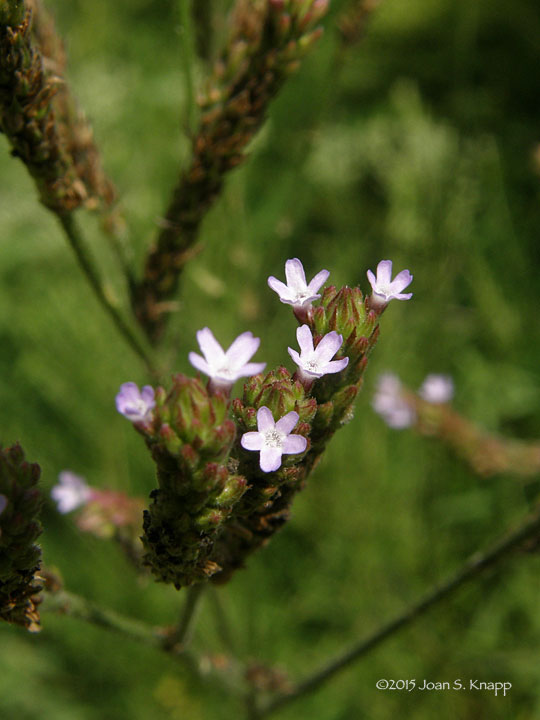
Brazilian Vervain (Verbena brasiliensis) had been blooming on the lower section of open trail for most of the summer.


The final treat of this walk was when I reached the Trumpetweed/Joe Pye Weed (Eutrochium fistulosum). I could see a couple of Eastern Tiger Swallowtails (Papilio glaucus) feeding high in the tall plant. The real treat was in the…


smaller plants, where I found six Eastern Tiger Swallowtails feeding, including a…


normal and a black female, as well as at least one…


male. A real treat!

Related posts:
- Summer On A Fort Yargo State Park Trail: Section B To The Dam, July 29th (Part 1)
- Spring Is In The Air: Fort Yargo State Park, Section B To The Dam, May 1st (Part 2)

Wednesday, October 7, 2015

Summer On A Fort Yargo State Park Trail: Section B To The Dam, August 12th (Part 1)


August 12th. When I visited Fort Yargo State Park in mid-February, there were few signs of Spring. The only wildflower plants that were obvious were the leaves of Cranefly Orchids (Tipularia discolor) that I found in many places.


The route… I’ve described it here, here, here, and here. This walk doesn’t have the variety of wildflowers as my other walk from the Group A Shelter to the Old Fort but it does have some gems. One of the Smallflower (Asimina parviflora) had developed fruit that, unfortunately, it had lost; the Pink Lady’s Slipper (Cypripedium acaule) Orchids had bloomed, and some Green Adder’s-mouth (Malaxis unifolia) Orchids had bloomed and two were setting seeds. The slime molds appeared to be finished for the season. For the moment, some wildflowers we still blooming but there was a lull between seasons.


Kudzu (Pueraria montana) vines – blooming in the woods the previous week - were blooming in the open near the beginning of the trail. 

I hadn’t seen dragonflies along this section of the trail this year. But, on this day, a…


female Eastern Pondhawk (Erythemis simplicicollis) was hunting  at the edge of the Kudzu.


In the woods, St. Andrew’s Cross (Hypericum hypericioides) plants were still blooming.


The Witch’s Butter (Tremella mesenterica) that rehydrated after recent rains; a Leopard Slug (Limax maximus) was happily munching on it. I’ve seen a lot of Leopard slugs on mushrooms and slime molds, as well as munching on lichens; no wonder the ‘vegetation’ looks ragged at times.


The Bicolor Lespedeza (Lespedeza bicolor) was still blooming; this is one of the longest blooming plants in these woods. 

On the previous walk, there weren’t any slime mold fruiting bodies at either of the two logs I visited on the way to the dam, but on this walk I found…


Dog Vomit/Scrambled Egg (Fuligo septica), and both…


immature (pink), and…


brown, mature Wolf’s Milk (Lycogala epidendrum) fruiting bodies. The upper photo has clusters of stalks left from Chocolate Tube (Stemonitis sp.) fruiting bodies.


The fruit on the Tulip Poplar (Liriodendron tulipifera) tree looked unchanged from the previous week; in fact, it’s looked like this for months now.


The Lanceleaf Coreopsis (Coreopsis lanceolata) had put on some new flowers. The flowers are smaller than that had been in spring.


A Red-spotted Purple (Limenitis arthemis) was basking in the sun at the end of the dam. 
(To be continued…) 

Related posts: 
- Summer On A Fort Yargo State Park Trail: Section B To The Dam, July 29th (Part 1)
- Spring Is In The Air: Fort Yargo State Park, Section B To The Dam, May 1st (Part 2)

Tuesday, October 6, 2015

When The Model Takes Over The Photoshoot


August 10th. I always take any opportunity to photograph Chinese Mantises. They are usually agitated when I first catch them but they seem to sense that I mean them no harm and settle down and start climbing over me – usually up my arm onto my shoulder or head. 

This female – she was heavy with eggs – had different ideas. She started to climb over my camera and the light I use for macro shots.


I managed to unscrew the light and took a couple of shots of her occupying the light. Positively sassy!