Tuesday, July 7, 2015

Spring Walk At Fort Yargo State Park: Shelter A To The Old Fort, June 15th, 2015 (Part 2)


June 15th. (Continued from…) I started to walk again at Fort Yargo State Park in Winder, Georgia. One of my favorite walks is from the Group Shelter A to the Old Fort and back.This is a rewarding walk for viewing wildflowers and I’ve been trying to walk it weekly and document the wildflowers I see.


The route, which I described here, here, and here. 

The early spring wildflowers have finished blooming; it’s time to watch the developing fruit. A few late spring/summer wildflowers are blooming now.

I solved part of a mystery on this walk. Some time previously, I had photographed this…


fungus that looked like an ornate bracket fungus but I hadn’t been able to identify it. Sometime since my previous walk, something/someone had…


knocked a section from one of them. Suddenly the mystery was partially solved. This was composed of several bracket fungi with…

relatively deep pores – about ¼ inch deep at the center. These were definitely…

polypores; I managed to detach a section of one bracket to comfirm the presence of pores. These individual bracket fungi had drooped to overlap and, unlike many mushrooms that would simply dry up and fall off, had dried to give the impression of a single entity. I should have figured it out but this exposure had certainly clarified what had happened. They were still leathery to the touch but were dead. Ants had built nests in the snag; the ants may have eaten the mycelium. Now to try and identify them. 

Another surprise. On the uphill side of the trail, I found several stalks of…


Nakedflower Ticktrefoil (Desmodium nudiflorum) were blooming. I’d forgotten they were here. I prefer desmodiums to lespedezas – the clear flowers with the two accent ‘eyes’ - so I was delighted to find these.


The second Eastern Sweetshrub (Calycanthus floridus) seedpod was doing nicely. I tend to miss it now that its weight has caused it to droop below the leaves (Top) and have to carefully move the leaves aside (Bottom) to expose it for a good photo.
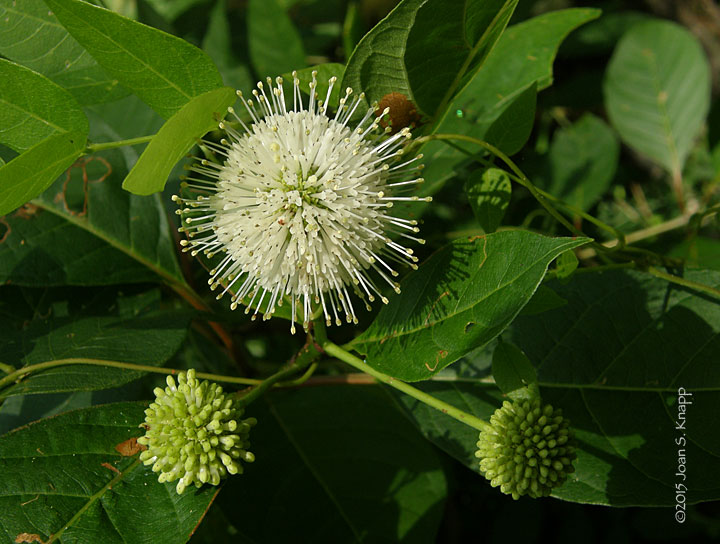

When I got to the Fishing Area, I found that the Buttonbush (Cephalanthus occidentalis) bushes had started to bloom.


I found this small hoverfly - Toxomerus geminatus – feeding on the flowers. (Thanks to Bug Guide for this identification). 

This was a good day for dragonflies and damselflies.


This Slaty Skimmer (Libellula incesta) let me get quite close. While I was photographing it flew over to a sweetgum leaf out over the water and, a few minutes later, returned to a…


nearby branch with a mate in tow - literally.


There were also a lot of male Blue Dashers (Pachydiplax longipennis) flying around in the area; this was the favorite perch. I didn’t see any female Blue Dashers in the area.


The Perfoliate Bellwort (Uvularia perfoliata) seed capsule was still developing.


I also found another small Strawberry Bush (Euonymus americanus) bush with developing fruit.


I made my way along to the Old Fort.


Another Buttonbush and a sedge were blooming. 

By the trail back down to the Fishing Area, I found more…

Pipsissewas with developing seed capsules. 

Back at the Fishing Area, where I had seen the dragonfly, there were a…


pair of Blue-fronted Dancers (Argia apicalis) damselflies that had mated. The female was laying eggs.


A Pipevine Swallowtail (Battus philenor) was resting on a branch nearby.


The final ‘find’ for the day were some Annual Blue-eyed Grasses (Sisyrinchium rosulatum) in bloom. 

Related posts: 

Sunday, July 5, 2015

Spring Walk At Fort Yargo State Park: Shelter A To The Old Fort, June 15th, 2015 (Part 1)


June 15th. I started to walk again at Fort Yargo State Park in Winder, Georgia. One of my favorite walks is from the Group Shelter A to the Old Fort and back.This is a rewarding walk for viewing wildflowers and I’ve been trying to walk it weekly and document the wildflowers I see.


The route, which I described here, here, and here.
The early spring wildflowers have finshed blooming; it’s time to watch the developing fruit. A few late spring/summer wildflowers are blooming now.


It’s not often that a walk starts out like this. An early morning disk golfer had started a Raccon (Procyon lotor) that had taken refuge up a tree. Poor little thing. It was way higher than it needed to go to be safe from us – as if we were a threat to it.


It was another sunny morning. Even the mornings are warm now and the sun is hot. The benches placed at strategic spots are welcome, particularly on the return walk.


I was surprised to find a Pigeonwings (Clitoria mariana) bloom in the woods at the beginning of the trail. I’d never seen one here before.


The seed capsules were still developing on this Strawberry Bush (Euonymus americanus). The seed capsules seem to stay at the same size forever.


Several Starry Rosinweed (Silphium astericus) were blooming by the trail near the Strawberry Bush, and the…


Lanceleaf Loosestrife (Lysimachia lanceolata) plants were still blooming. There were about five plants and they’d been blooming for a couple of weeks already; I was surprised that they had bloomed for so long.


The berries on the Solomon’s Seal (Polygonatum biflorum) plants just before the first bridge were still developing nicely, as were the…


seed capsules on the Pipsissewa (Chimaphila maculata) on the rise just after the bridge, and the…


berries on the Deerbery (Vaccinium staminium) bushes were still developing. 

I keep my fingers crossed when I walk up to the… 


Eastern Sweetshrub (Calycanthus floridus) plant, but no need to worry on this day. The fruit was still developing. It hasn’t changed size for a long time. I guess it has reached its maximum size and it will just take time to mature now. 


The seed capsules on Wild Yam (Dioscorea villosa) vines were still doing nicely too. 

On my previous walk, I’d found the mushroom that I had identified as Black Chantarelles (Craterellus cornucopioides). This was an exciting find. I have seen the yellow Chanterells (Cantharellus cibarius) in several locations but had never seen the Black Chantarelles. In fact, I didn’t know they existed until I found these. I had gotten relatively good photographs of them from above but I wanted to photograph them again from the side. I was delighted that they were…


still in good shape. I actually got the towel that I carry and lay on the ground to photograph them this time.


From the top, and…


from the side. The top image shows the depth of the characteristic inverted, funnel-shaped cap. The lower image shows how shallow or almost non-existent the folds or false gills are.


It wasn’t far to the witchhazel bush (Hamamelis sp.) to find that the seed capsules were still doing well. 

There were still a couple of surprises before I left the cliff area for the Fishing Area, the ‘Rock Garden,’ and the Old Fort.
(To be continued…)

Related posts: 

Saturday, July 4, 2015

Greenhouse Camel Cricket (Diestrammena asynamora)


June 9th.  I found this…


cricket in the kitchen one morning. I’m not sure how it got there, but there it was. I knew it was a cricket but I didn’t know what type it was. So, I consulted Bug Guide and tracked it down; it was a Greenhouse Camel Cricket (Diestrammena asynamora). Bug Guide confirmed my identification.


Its body was about one inch long; about two-to-three times the size of the native crickets we see. Needless to say…


I released it outside.

This is the first time I’ve seen one of these crickets in the 27-plus years we’ve lived here. I’ve since found a second one – perhaps the first one making its way back into the house.
Greenhouse Camel Crickets, also known as Cave Crickets, originated in Asia and were first sighted in the United States in the 19th Century. 

Until recently, they were found mainly in greenhouses, hence their common name. However, now they are being found in homes in the eastern U.S. where they may outnumber the native crickets.They are harmless to humans and scavenge dead material in basements and garages.

The question will be – Will they become a major pest in the future?

Reference: 

Friday, July 3, 2015

Coral Slime Mold (Ceratiomyxa fruticulosa)


June 4th was the first day that I saw slime molds at Fort Yargo State Park.


I noticed a lot of white material on rotten logs. I usually think of fungal mycelium - that is all but unidentifiable without fruiting bodies - when I see this. But, having seen the Red Raspberry slime mold earlier, I took a closer look and found that this was also a slime mold that I was able to identify as Coral Slime (Ceratiomyxa fruticulosa). I saw this slime mold on a lot of moist, rotting logs. 

Slime molds are fascinating. They have two stages; a plasmodial stage and a spore forming stage. The plasmodium is an aggregate of cells with membranes but no ‘solid’ cell walls. Like amoebas, the cells move across surfaces and engulf food. Something triggers the plasmodium to form fruiting structures which range from very simple to complex. Coral Slime forms clusters of simple, cylindrical fruiting structures. 

I took a lot of photos and pieced together a series showing the development of this slime mold.


The plasmodium is clear at first and…


the sporangia start to form from areas that have become milky in appearance.


Clusters of sporangia form. An individual sporangium is less than a millimeter in diameter and three to four millimeters in length. Sporangia are clear at first and become…


opaque with an increasingly…


powdery in appearance when they mature.


A cluster of sporangia that still has some clear and opaque areas of plasmodium that will also form sporangia.

Coral Slime was, by far, the most common slime mold on this day. It was ‘everywhere.’

References: 
- Messiah College: Ceratiomyxa fruticulosa 
- Biology Reference: Slime Molds 

Related posts:

Thursday, July 2, 2015

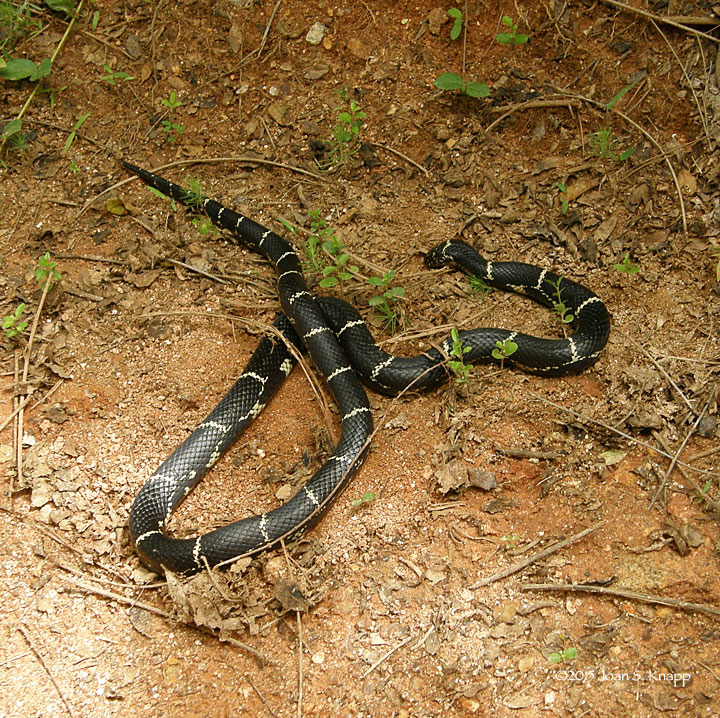
Eastern Kingsnake (Lampropeltis getula getula)


June 12th. I was on the final leg of the trail from the Section B parking lot to the dam at Fort Yargo State Park. This year, I’d met two snakes – Black Rat Snakes (Elaphe obsoleta) – along this section of the trail. So I’m always on the lookout for snakes along this section of the trail where there are woods to the east and the open area to the west is covered with Kudzu vines. 

I’d completed the first flat section of trail and was just starting down the hill to the final flat section of trail when I saw it…  A big snake…


Immediately recognizable as an Eastern Kingsnake (Lampropeltis getula getula) or Chain Kingsnake, a black snake that has thin white bands. It was about four feet long. At first, it didn’t look like it was moving but then it became apparent that it was moving very slowly. It seem oblivious to the fact that I was standing only about two to three feet from it.


It was poking its nose into the soft surface of the gravel-clay soil as if it was looking for food.


It didn’t seem to be sensing with its tongue, but it definitely was...
 
digging its nose in the soil.


It almost looked as if it was ‘mouthing’ the soil as it went.


Finally, it had apparently exhausted its interest in this area and slithered effortlessly up the almost vertical embankment before disappearing into the woods. This encounter seemed to take forever but, according to my camera, was only three to four minutes long. 

Eastern Kingsnakes are constrictors; they eat snakes including venomous snakes such as Copperheads (Agkistrodon contortrix), skinks, reptile eggs, rodents, birds and their eggs, and frogs. I couldn’t find any reference to this snake eatings insects but I did find a reference to the Eastern Black Kingsnake (Lampropeltis getula nigra) eating insects. I’m assuming that this subspecies would also eat insects and that this snake was looking for a snack.

Related post: