Tuesday, July 21, 2015

Orange Sponge Polypore (Pycnoporellus alboluteus)?


June 22nd. When I was walking along the trail from the Old Fort to the Picnic Shelter A at Fort Yargo State Park, I noticed a large patch of fungus on the side of a large, fallen pine log. I almost ignored it but decided to make my way through a jumble of fallen tree trunks to take a closer look. I’m glad I did. I was expecting to find a crust fungus but may have found a much more interesting fungus.


The fungus, at its longest point, covered about three feet on the ‘underside’ of the log.


As I got closer, I could see that it wasn’t a crust fungus. It appeared to be a polypore of some kind.


The fungus had no caps and looked like a collection of curtains hanging on the underside of the log.

A closer view of this fungus. It was golden-orange with white tips.; its tubes were folded, with an irregular, hanging curtain appearance; its tubes were 1 to 2 cm long. It felt soft and spongy.


A close-up view. This view shows, in considerable detail, the yellow-orange color of the fungus with its irregular, ‘eroded,’ ‘veil-like’ appearance.

It was hard to get a mental image of what the pores would look like. I couldn’t get my camera lens in a position to photograph the pores on June 22nd. I returned on June 28th with a mirror that would fit under the log. By this time,…


patches of the fungus had fallen off.


I was able to photograph the pores; they were very irregular.


I found another, much smaller patch of this fungus – about nine or ten inches long – on a fallen pine log on the trail from the Section B parking lot to the dam.

The description of the fungus talks about ‘erosion’ of the fungus. It seems that


slugs may contribute to this erosion. This slug was grazing on this smaller patch of fungus.


I was able to get photographs of the pores of this younger fungus that also showed the irregular pore shape that I’d observed with the first colony. I wasn’t able to perform the potassium hydroxide test or get a spore print; these will have to wait until next year.

When I tried to identify this fungus, the description of the Orange Sponge Polypore (Pycnoporellus alboluteus) matched the images that I had collected. The description given by Mushroom Expert indicates that this species is saprophytic. grows on the dead wood of conifirs, and spreads along the underside of the log. In some areas it fruits in spring to summer or summer to fall.

This species usually lacks any cap, may spread for a meter or more. Its flesh is soft and spongy, appears felty or finely hairy; its tubes may be 2 cm long, its pores are angular/irregular and 1 mm or more across. The pore surface erodes to create an irregular, toothed appearance. The flesh is thin and bright orange in appearance, fading to paler orange. The species has a white spore print and stains bright red with potassium hydroxide. 

The species is reported to occur mainly in western North America and at higher altitude, and occasionally (rarely) in the northeastern North America. Based on submissions to Mushroom Observer, most reports of this species have been made from Colorado, California, Oregon, Montana, Idaho, Wyoming . A couple of reports have been made from the northeastern North America: Pennsylvania,

The fungi I found match the description for Pycnoporellus alboluteus. The locations of the fungi I found are, however, far further south than has been reported previously and at a much lower altitude (254 m) than other observations. Both locations were west-facing but in shaded areas that were moist and receive little or no direct sunlight. The larger fungus was in an area that receives little, or no, direct sunlight and the smaller fungus was in an area that is drier and receives limited sunlight. If this fungus is not Pycnoporellus alboluteus, it is probably a related, previously undescribed, Pycnoporellus species, that tolerates higher temperatures. Either way, an exciting find. 

Reference:  
- Mushroom Expert. Pycnoporellus alboluteus
- Roger’s Mushrooms. Pycnoporellus alboluteus

Related posts: 

Sunday, July 19, 2015

Summer At Fort Yargo State Park: Shelter A To The Old Fort, June 22nd, 2015 (Part 2)


June 22nd. (Continued from…)  I started to walk again at Fort Yargo State Park in Winder, Georgia. One of my favorite walks is from the Group Shelter A to the Old Fort and back.This is a rewarding walk for viewing wildflowers and I’ve been trying to walk it weekly and document the wildflowers I see. 


The route, which I described here, here, and here. 

The early spring wildflowers have finshed blooming; it’s time to watch the developing fruit. A few late spring/summer wildflowers are blooming now. 

The Buttonbushes at the end of the bridge into the Fishing Area were still blooming. There were…


buds,...


flowers in full bloom,...


flowers that had finished blooming, and some that were…


ready to form seeds.


Some Carolina Wild Petunias (Ruellia caroliniensis) were still blooming.


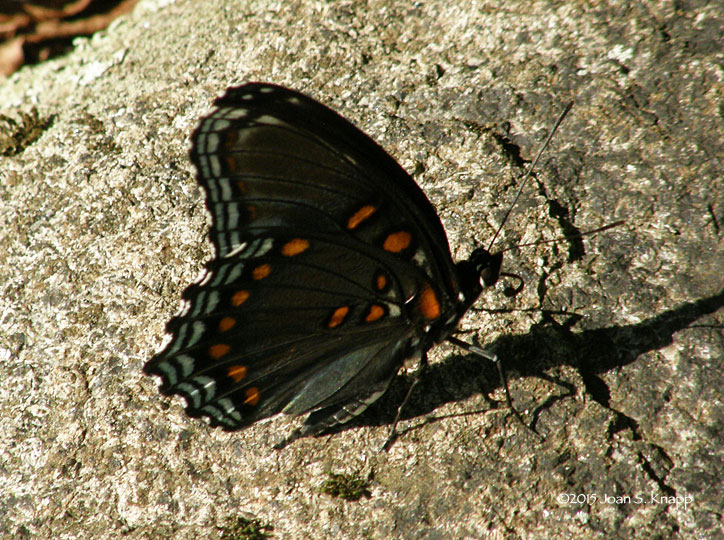
Nearby, a Red-spotted Purple (Limenitis arthemis) was resting. It was so hot that the butterflies were closing their wings as soon as they landed.


In the ‘Rock Garden,’ the seed capsule on the Perfoliate Bellwort (Uvularia perfoliata) was still doing well, as were the…


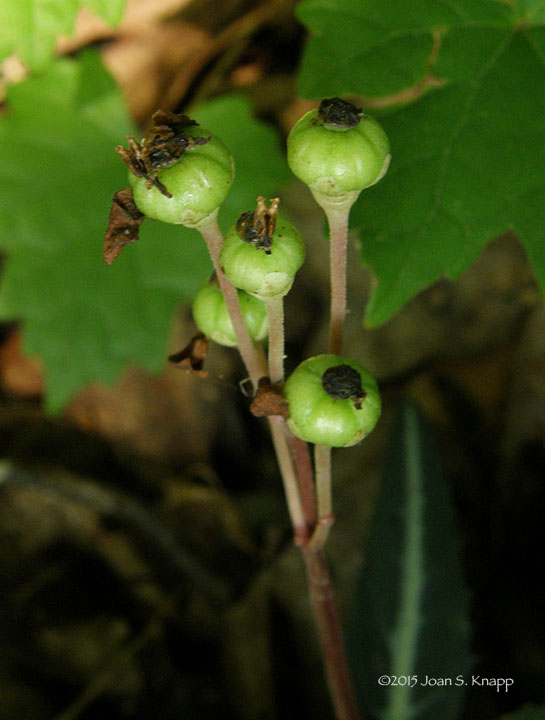
seed capsules on the Pipsissewa (Chimaphila maculata) plants. 

As I was walking down the trail to the Old Fort, I was startled so see a…


Large jelly fungus that had grown on a small, fallen tree trunk. This was a…


Snow Fungus (Tremella fuciformis). This is an edible fungus and, when I was identifying it, I was a little amused to find more information on commercial, rather than scientific, sources of information for it.


In addition to the large fungus, there were some small patches of this same fungus at the opposite end of the trunk. 

On my return walk along this same section of trail I noticed a large patch of fungus on a fallen log just beyond the Snow Fungus. I almost ignored it but decided to make my way through a jumble of fallen tree trunks to take a closer look. I’m glad I did. I was expecting to find a crust fungus but may have found…

something much more interesting. More of that next…

Related posts:

Saturday, July 18, 2015

Summer At Fort Yargo State Park: Shelter A To The Old Fort, June 22nd, 2015 (Part 1)

June 22nd. I started to walk again at Fort Yargo State Park in Winder, Georgia. One of my favorite walks is from the Group Shelter A to the Old Fort and back.This is a rewarding walk for viewing wildflowers and I’ve been trying to walk it weekly and document the wildflowers I see.


The route, which I described here, here, and here. 

The early spring wildflowers have finished blooming; it’s time to watch the developing fruit. A few late spring/summer wildflowers are blooming now.


It was a short stalk, only about 18 inches tall. There was only one stalk; I almost missed it.


I believe it was a Pale-spiked Lobelia (Lobelia spicata).


The seed capsules were still developing on this Strawberry Bush (Euonymus americanus). The seed capsules may have swollen slightly. There didn’t seem to be has many as there had been.


Starry Rosinweed (Silphium astericus) were still blooming by the trail just beyond the Strawberry Bush. I didn’t realize that they bloomed for so long.


The Helmetflower (Scutellaria integrifolia) plants had finished blooming and setting seed. All that remained on most plants was the lower persistent ‘dish.’ I did find…


one capsule that had opened to release the nutlet but still retained the upper part attached to the lower dish. 


As I made my way back towards the trail, I found…


American Groundnut (Apios americana) flowers on a vine that had climbed up some blackberry canes. I’m glad I stopped to photographed them; they had finished blooming by the next week.


Unripe blackberries on the canes supporting the American Groundnut vines. 


I was disappointed to find both of the Solomon’s Seal (Polygonatum biflorum) plants I’d been following had disappeared. I think deer must have eaten them.


There were, however, a few more plants that still had berries.


The Pipsissewa (Chimaphila maculata) seed capsules just past the first bridge, were still health, as were the…


berries on the Deerberry (Vaccinium staminium) bushes, and the…


seed capsule on theEastern Sweetshrub (Calycanthus floridus) plant 


The Black Chanterelles (Craterellus cornucopioides) mushrooms were just blackened remains but the...


seed capsules on Wild Yam (Dioscorea villosa) vines were still doing nicely too.


A little distance below the trail, Smooth Yellow False Foxglove (Auriolaria flava) plants were blooming. 


As I walked along the trail, I heard a soft tapping high in a tree nearby. I managed to track the noise and saw a…


male Red-bellied Woodpecker (Melanerpes carolinus) pecking on a snag to find insects. A second woodpecker flew over to join the first one but flew off before I could photograph them together.


Nakedflower Ticktrefoil (Desmodium nudiflorum) stalks were still blooming. There were many more than I realized. I’ve counted about 20 blooming above the trail above the cliff.


The seed capsules on the witch hazel bush (Hamamelis sp.) were still doing well, as were those on the...


Mountain Azalea (Rhododendron canescens) bush at the top of the cliff.


I keep forgetting about the second seed capsule on the bush above the cliff because it’s almost hidden below the leaves.


Push the leaves aside and the healthy seed capsule it still doing well.
While I was photographing the Nakedflower Ticktrefoil flowers, I stumbled on some very attractive… 


bracket fungi. 

Then, onto the Fishing Area and the ‘Rock Garden.’ 
(To be continued…) 

Related posts: