Tuesday, August 11, 2015

Summer At Fort Yargo State Park: Shelter A To The Old Fort, July 6th, 2015 (Part 2)


July 6th. (Continued from…) I started to walk again at Fort Yargo State Park in Winder, Georgia. One of my favorite walks is from the Group Shelter A to the Old Fort and back.This is a rewarding walk for viewing wildflowers and I’ve been trying to walk it weekly and document the wildflowers I see.


The route, which I described here, here, and here.
The early spring wildflowers have finished blooming; it’s time to watch the developing fruit. A few late spring/summer wildflowers are blooming now.


As I made my way over to the ‘Rock Garden,’ I found a lone Starry Rosinweed (Silphium astericus) blooming. It’s unusual to find this plant near the Fishing Area.


A dead Eastern Red Cedar (Juniperus virginiana) had been cut down. The…


cut was fresh; the colors of the wood were vibrant and the scent of cedar filled the air in the immediate area.


The Resurrection Fern (Pleopeltis polypodioides) on a tree trunk in the Rock Garden, dry the week previously, has been ‘resurrected’ yet again.


The Wild Yam (Dioscoria villosa) with seed capsules, and the…


Eastern Sweetshrub (Calycanthus floridus) both look healthy.


Smooth Yellow False Foxglove (Aureolaria flava) plants were ‘between’ blooms but there are many buds still to open.


The Perfoliate Bellwort (Uvularia perfoliata) still had its seed capsule.


One of several Nakedflower Ticktrefoil (Desmodium nudiflorum) plants in this area was blooming, with a tiny seed pod already forming from a ‘spent’ flower.


Near the end of the Rock Garden trail, I found clusters of tiny white mushrooms on dead wood. Their caps were only about 0.5 inches in diameter and 1 to 2 inches tall.

I walked over to the main trail towards the Old Fort.


The fallen log that had previously had Snow Fungus (Tremella fuciformis), had some new fungus, and I found a few...


young pink Wolf’s Milk (Lycogala epidendrum) slime mold fruiting bodies on a more-decayed log nearby.

In the grass by the footpath along the edge of the lake, I found a couple of…
 
Pleated Inkcap (Parasola plicatilis) mushrooms. 

The Swamp Rosemallow (Hibiscus moscheutos) bush was in…


full-bloom, and was already...


developing seed capsules.


A Bigroot Morning-glory (Ipomoea pandurata) was blooming just inside the edge of the woods. This isn’t a robust vine and these were the only blooms I’ve seen here; this isn’t a good spot to look for these. 

I had been keeping my eye open for Cranefly (TIpularia discolor) orchid blooms. Since the leaves have ‘disappeared’ before the orchids bloom, it’s a case of trying to remember where I’d seen the leaves. This day was ‘the’ day. I found…


flower stalks just emerging in a couple of locations. It’s be a week or so before blooms would appear. 

Just south of the Fishing Area, I found another…


Dog Vomit (Fuligo septica) slime mold fruiting body forming. 

A little further south, I happened to look further up a gully from the trail and spotted many mushrooms growing on a decaying log. It was about 30 to 40 feet from the trail. I had to decide if it was worth navigating my way across to it and possibly sitting – inevitably – in the wet leaves to photograph them. I’m glad I decided to.

A colony of mushrooms. They were in good condition.


A cluster of the mushrooms, and an…


individual mushroom. I identified this mushroom as the Golden-gilled Gerronema mushroom (Gerronema strombodes). 


Rather than walk back to the trail from the direction I’d come, I decided to leave the gully from its south side. As I reached the top of the gully, I spotted…


fungi on another decaying log. They were…


Crown-tipped Coral fungi (Artomyces pyxidatus; formerly Clavicorona pyxidata). These fungi, also, were in pristine condition and I spent many more minutes sitting in wet leaves to photograph these. But they were worth it. 


The final sighting for the walk was a cluster of Turkey Tail (Trametes versicolor) bracket fungi on the end of a log. 

It’s interesting that, although I anticipate just checking on fruits of various plants and the ‘usual suspect’ wildflowers, I seem to find things that I didn’t expect. That’s what makes these walks interesting.

Reference:
- Mushroom Expert: Gerronema strombodes 

- Related posts:

Monday, August 10, 2015

Summer At Fort Yargo State Park: Shelter A To The Old Fort, July 6th, 2015 (Part 1)


July 6th. I started to walk again at Fort Yargo State Park in Winder, Georgia. One of my favorite walks is from the Group Shelter A to the Old Fort and back.This is a rewarding walk for viewing wildflowers and I’ve been trying to walk it weekly and document the wildflowers I see.


The route, which I described here, here, and here. The early spring wildflowers have finished blooming; it’s time to watch the developing fruit. A few late spring/summer wildflowers are blooming now.


Starry Rosinweed (Silphium astericus) were still blooming by the trail just beyond the Strawberry Bush. I wonder how long they will continue to bloom.


The seed capsules were still developing on this Strawberry Bush (Euonymus americanus). The seed capsules may have swollen slightly but there weren’t as many as there had been at first.


A small Hairy Angelica (Angelica venenosa) was blooming. It was barely three feet tall. At one time, there were several large plants in this area. I wonder if continued mowing of the area, particularly at the wrong time, has resulted in their demise.


A small Spurred Butterflypea (Centrosema virginanum) vine was starting to bloom. The vine was climbing up a blackberry cane; the flowers was partly hidden by its leaves.


The surviving Solomon’s Seal (Polygonatum biflorum) plants, that had not been eaten, still had berries that were ripening. They ripen fairly slowly. 

There is a large fallen log between the Solomon’s Seal plants grow and the first bridge. As I walked past, I saw some, what I through at the time were Coral Slime (Ceratiomyxa fruticulosa var. fruticulosa) fruting bodies. I almost didn’t stop to photograph them but they were in a much more open, sunny area than I would expect to see these. I photographed them almost half-heartedly. Imagine my surprise when I processed the images to find that I had photographed…


Ceratiomyxa fruticulosa var. porioides fruiting bodies early in their formation. The fruiting bodies were still transparent, and it was easy to see the honeycomb structure. This was another one of the slime molds that I hadn’t expected to ever see. An exciting find!


The seed capsules on the Pipsissewa (Chimaphila maculata) just past the first bridge, were still healthy – and enchanting.

Finally! A ripe - at least very dark - berry on the Deerberry (Vaccinium staminium) bush. I only saw this one 'ripe' berry. They're probably eaten as soon as they are tolerably ripe, as most of the berries on this particular bush have disappeared. 

The seed capsule on the Eastern Sweetshrub (Calycanthus floridus) plant was still hard. I’m very hopeful that it will ‘make it’ now.


The seed capsules on Wild Yam (Dioscorea villosa) vines were still doing nicely too. Once I found them, I haven’t had much doubt that they would survive to maturity; my only regret is that I missed the very early stage of their development.


The seed capsules on the witchhazel bush (Hamamelis sp.) were still doing well. I haven’t seen any attrition of these at all. But, on this occasion, a change caught my eye.


Small ‘growths’ at the leaf axils. The first signs of flower buds for this season. Judging by the number, I don’t think there will be as many flowers as last season.


The seed capsules are still healthy on the Mountain Azalea (Rhododendron canescens) bush at the top of the cliff.


The Nakedflower Ticktrefoil (Desmodium nudiflorum) stalks were still blooming. I noticed, when processing this image, that there is a tiny seed pod forming at the right side of the flower stalk. Did you know that the seed pod of a leguminous plant like this is called a loment? A loment, when mature, breaks up into one-seeded joints.


The seed capsule on the Eastern Sweetshrub bush at the top of the cliff. This combined image shows the capsule partially hidden under the leaves (left), and with the leaves held aside (right). It’s easy to miss this capsule if I forget to look. 

Just a little further along the trail above the cliff, I found a…


small Dog Vomit (Fuligo septica) fruiting structure. The white material at the left is plasmodium that has not been incorporated in the fruiting structure. I had never seen a Fuligo septica fruiting structure as yellow as this one. 

I walked down towards the Fishing Area and found these fruit, drupes, on a…


Blackgum (Nyssa sylvatica) tree. I had seen flowers in the past but this was the first time I had seen the fruit. 

I walked over the bridge into the Fishing Area.


Fruit are still in the early stages of development on the Buttonbushes (Cephalanthus occidentalis). I’ve never seen these mature before either so I’m following them with some interest.


The fruit on the Silky Dogwood (Cornus alternifolia) and the…


Hazel Alder (Alnus serrulata) looked healthy. Sadly, these bushes were pruned severely and I won’t see these mature this year.


The final sighting before heading towards the ‘Rock Garden’ was Carolina Wild Petunia (Ruellia caroliniensis), quietly blooming in the shade near the point. 
(To be continued…)

Related posts:

Sunday, August 9, 2015

Beetles Around The House: Spined Oak Borer Beetle (Elaphidion mucronatum) and Zebra Longhorn Beetle (Typocerus zebra)


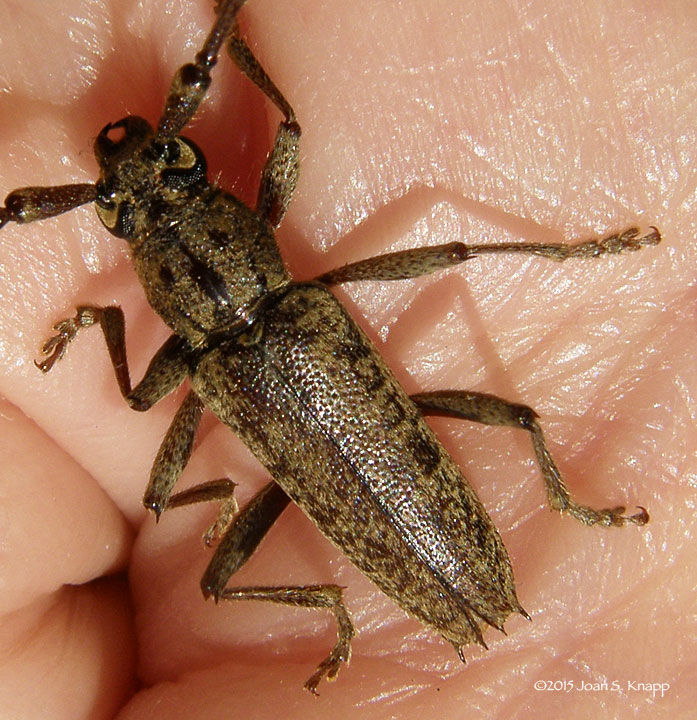
June 17th. Spined Oak Borer Beetle (Elaphidion mucronatum)


I found this beetle in the kitchen. I’m not sure how it got there but I took it outside to photograph it and let it go. Then I had to learn something about it. Bug Guide provided the identification.

The specific epithet (species name) ‘mucronatum’ means ‘pointed’ and refers to sharp femoral spines; a spine is clearly visible on the second leg in the lower image. Beetles are 12-20 mm in length with very long antennae, in this case almost twice the length of its body. 

They are considered very common in the southeastern United States but their range extends from Ontario to Minnesota, south to Arizona and Florida. They have a wide range of host plants include most eastern hardwoods & shrubs. They lay their eggs under the bark of dead hardwoods. Their larvae feed beneath the bark during their first year and then deeper during the second year.

June 30th. Zebra Longhorn Beetle (Typocerus zebra)


We have a small area of wildflowers under one of the Pecan trees in the field. Purple coneflowers and Butterfly Milkweeds have bloomed here for several years. We don’t mow the area when these plants are blooming. Consequently, other plants such as goldenrods fill the area as well. 

So, it was only when I wandered deep into the chest-high area that I discovered a couple of small Yuccaleaf eryngo (Eryngium yuccifolium) had volunteered in the patch and were also blooming. And there on the Yuccaleaf Eryingo was a Zebra Longhorn Beetle (Typocerus zebra). It was a nicely colored beetle with strong, clearly defined bands of ochre yellow on a dark background. A really nice specimen since the bands on many beetles may appear 'faded.'

The specific epithet ‘zebra’ refers to the striped pattern on the elytra (wing casings). The pattern on the elytra is distinctive with the small yellow triangular or hook markings at the top of the elytra next to the pronotum. Beetles are 8 to 17mm long with relatively short antennae (compared with the oak borer).

These beetles range from Virginia to Oklahoma, and south to Texas and Florida. They are found on flowers in fields, roadsides, mostly adjacent to woodlands with pines, mainly between March and July based on submissions to Bug Guide. They are thought to feed on nectar and pollen. Their larvae live in decaying pine stumps.

References: