Tuesday, November 17, 2015

Summer At Fort Yargo State Park: Shelter A To The Old Fort, August 25th, 2015 (Part 1)


August 25th. I started to walk again at Fort Yargo State Park in Winder, Georgia. One of my favorite walks is from the Group Shelter A to the Old Fort and back.This is a rewarding walk for viewing wildflowers and I’ve been trying to walk it weekly and document the wildflowers I see.


The route, which I described here, here, and here.
 
The early spring wildflowers have finished blooming; it’s time to watch the developing fruit. Summer wildflowers were still blooming but it was time to turn attention to the fungi in the woods.

The first thing I saw near the beginning of the trail was surprising; slime mold fruiting bodies.


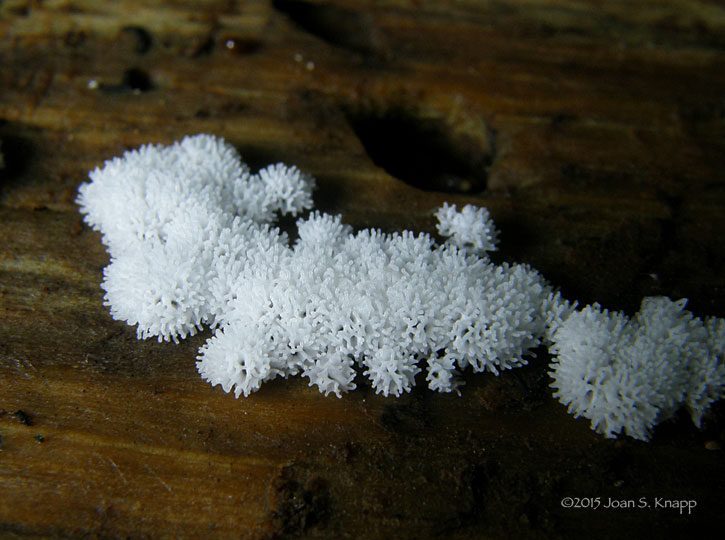
A cluster of ‘Honeycomb’ Coral Slime (Ceratiomyxa fruticulosa var. porioides) fruiting bodies had formed at the base of an old pine stump. This is one of my favorite slime molds although it’s hard to appreciate its structure when the fruiting bodies are mature and releasing their spores. Nevertheless, I was excited to see them.


A little further along the trail, I spotted a eupatorium a little distance from the trail. Closer inspection showed it was a single Roundleaf Thoroughwort (Eupatorium rotundifolium) plant in bloom. It was the only plant of this species that I’ve seen in the park. I’m afraid that the trees are going to shade it out. 

On the other side of the trail, still in the pine forest, I found a ‘new’ mushroom.


Superficially, it was similar to the Ornate-stalked Bolete (Retiboletus ornatipes) but the cap was a deeper color (although not as deep a red as I have seen since.) This mushroom was also a bolete with pores instead of gills. Unlike the Ornate-stalked Bolete, this mushroom had a reddish color under the ornate stem. This was the Shaggy Stalked Bolete (Heimioporus betula). 

Just beyond the pine forest, there are three old logs, probably pine, that are covered with small bracket fungi. I had to stop and take a closer look at them. There were at least two different types of fungi on these logs.


The first type were dark with light margins.


Their undersides were covered with pores. These were Turkey Tails (Trametes versicolor). Turkey Tail fungi can vary widely in color patterns.


Nearby were small bracket fungi that looked similar in shape and also had concentric color patterns. It would be easy to call them Turkey Tails but their


undersides had gills, not pores. These are called Gilled Polypores (Lenzites betulina).


Flowering Spurges (Euphorbia corollata) were still blooming in the open woods just beyond the pine forest.


The Virginia Meadowbeauty (Rhexia virginica) were also still blooming at the lake’s shore.


The fruit on the Strawberry Bush (Euonymus americanus) had developed a litle more pink color but they were still far from ripe.


The Small Wood Sunflower (Helianthus microcephalis) plants were still blooming in the shade along this section of the trail.


At the edge of the open woods, I found this small cousin of the Partridge Pea (Chamaecrista fasciculata) that grows along roadsides. This plant is the small Sensitive Partridge Pea (Chamaecrista nictitans). The plant was about 12 inches tall. In my experience, it’s unusual to see the the flowers fully open, but I was lucky enough to find one on this plant. 

I made my way along to the open area under the power line where a flash of red caught my eye.


It took me a couple of seconds to realize I was looking at fruit on another, large Strawberry Bush. These fruit were further along than those on the bush in the shade. 

Below them, closer to the water,…


a Perennial Wildbean (Strophostyles umbellata) was still blooming, as were…


Groundnut (Apios americanus),…


Pigeonwings (Clitoria mariana) and…


Spurred Butterflypea (Centrosema virginianum) vines.

From here, I walked along to the ‘first’ bridge.
(To be continued…) 

References: 
- Mushroom Expert. Kuo, M. (2010 March). Heimioporus betula. 
- Mushroom Expert. Kuo, M. (2005 March). Trametes versicolor. The turkey tail. 
- Mushroom Expert. Kuo, M. Lenzites betulina. The Gilled Polypore. 

Related posts: 

Monday, November 2, 2015

Larva: Peigler’s/Yellow-striped Oakworm Moth (Anisota peigleri)


July 24th - August 21st. I was walking along the trail by the lake in a deciduous forest with some…

 Post Oak (Quercus stellata) saplings. 

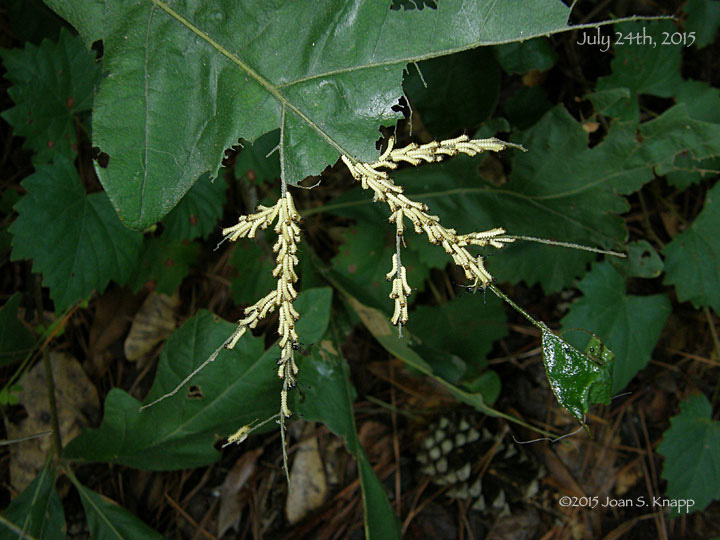
Something caught my eye. It took a couple of seconds to process what I was seeing…

a lot – and I mean a lot – of small larvae that had eaten away a number of leaves on a small oak sapling. They were in two groups, each heading in the same direction – towards the tip of lobes of a leaf.


A closer view.


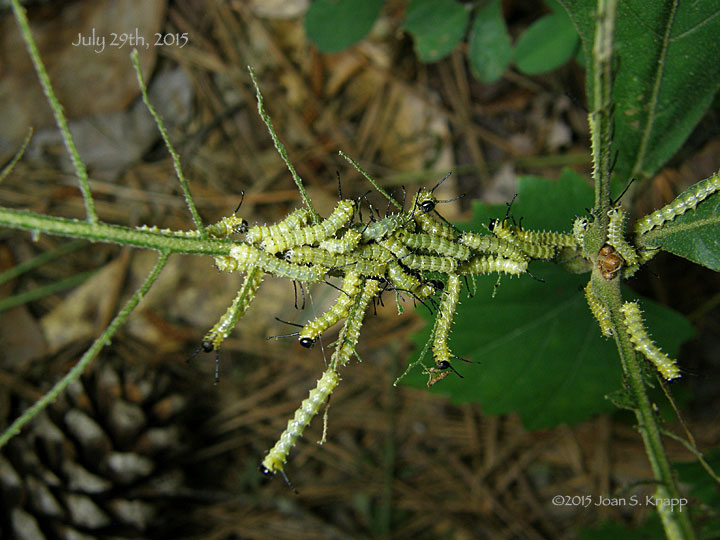
Each larva was approximately 3/8th inch long and 1/16 inch diameter. They had black heads; their T1 segment was tan with a dark band. They had short black horns and fine setae (hairs) on their abdominal segments.


A few larvae at the lead were evolving to the next instar stage; they had enlarged black heads, darkened thoraxes and abdomens with hints of lighter stripes, and longer setae than most of the larvae. 

I wasn’t sure how fast these larvae would develop so I went back on July 25th to photograph them again. At first I could see no sign of them. It was hard to imagine that the small larvae I had seen the day before could have disappeared completely. Then I looked on the underside of a leaf where I found the…


remains of the casings of the eggs from which they had hatched.


I found two groups of instars under different leaves. Apparently they had sheltered there during the night. All of the instars now had black heads.

My next visit was on July 29th
 
The instars hadn’t changed appreciably in appearance, although a little larger. 

I was a little anxious for them. They had almost depleted the leaves on this particular sapling. There were no other Post Oak saplings in the immediate vicinity, although there was one directly across the trail. When I returned the following week, I couldn’t find any sign of them. 

I identified the larvae as an Anisota (Oakworm Moth) larva, either Anisota senatoria or A. peigleri. I submitted photos of the instars to Bug Guide, where they were identified as larvae of A. peigleri, the Peigler’s Oakworm or Yellowstriped Moth. 

I thought that was the end of it – for this year. Then, on August 21st, when I was checking some bracket fungi approximately a half a mile from the location where I had found the first instars, I noticed another sapling that had been completely denuded. There were a few Post Oak saplings nearby and, not expecting to find anything, I climbed the embankment to examine them – just in case. To my delight, I found three…


stage 4 larvae, obviously from a different hatching. But it was nice to find some mature larvae. It was great to see the final stage after having seen the earliest stages.

Anisota peigleri is one of six species in the genus Anisota. The larvae of Anisota senatoria and A. finlayson are similar in appearance to A. peigleri and are assigned to the senatoria group. Larvae in this group are black with yellow or orange stripes; larvae of other species are different colors. A. senatoria is found in the eastern U.S. but not in the deep south or northern areas. A. finlayson is found in Ontario and Quebec. A. peigleri is found in the southeastern U.S. from the mountains of Virginia, Kentucky, and Tennessee to central Florida.

References: 
- Bug Guide: Genus Anisota.

Sunday, November 1, 2015

Little Nest Polypore (Poronidulus conchifer)


August 21st. I spotted these polypores on a small branch that had fallen during a recent storm.


From a distance, it was clear that they were something that I had never seen before, and not something that I would mistake for another fungus.


The mature polypores were approximately 1 to 1.5 inches ‘wide’ and 1 inch ‘deep.’ The ‘main’ polypores were a very pale cream color with zones of darker color. They were attached to the branch by a short ‘stem.’ Most of the large polypores had a small ‘cup’ at the point of attachment of the polypore to the branch. These cups were 0.25 to 0.75 inches wide, and had concentric zones of cream and dark browns or grays.


Further along the branch were small cups that didn't have the larger polypres.


The pores on the underside of the brackets were clearly visible to the naked eye in stark contrast to the pores on a Turkey Tail (Trametes versicolor) bracket. The pores were approximately 0.5 mm in diameter, angular, and irregularly shaped.


The caps also had pores of the same size as the larger polypore. 

It didn’t take long to identify these as the Little Nest Polypore (Poronidulus conchifer). These fungi are sometimes called Trametes conchifer in some field guides, but they have been assigned to their own genus. 

Poronidulus conchifer polypores grow on branches, stumps, and logs east of the Great Plains in North America.  The small caps develop first, and the larger polypore develops later. As they age, the small caps fall off, leaving the larger polypore. Aged polypores lose their color, and are stark white. It is rare to find photographs of fresh specimens.

So far, I have seen them on recently fallen branches in Barrow and Walton counties in Georgia. I have also weathered polypores on branches that had fallen in previous seasons.

Reference;
Kuo, M. (2010, March). Poronidulus conchifer.