Saturday, August 8, 2015

Summer On A Fort Yargo State Park Trail: Section B To The Dam, June 30th (Part 2)


June 30th. (Continued from…) When I visited Fort Yargo State Park in mid-February, there were few signs of Spring. The only wildflower plants that were obvious were the leaves of Cranefly Orchids (Tipularia discolor) that I found in many places.


The route… I’ve described it here, here, here, and here This walk doesn’t have the variety of wildflowers as my other walk from the Group A Shelter to the Old Fort but it does have some gems. One of the Smallflower Pawpaw (Asimina parviflora) had developed fruit that, unfortunately, it had lost; the Pink Lady’s Slipper (Cypripedium acaule) Orchids had bloomed, and some Green Adder’s-mouth (Malaxis unifolia) Orchids had bloomed and two were setting seeds. The occurrence of slime mold fruiting bodies added a new focus of interest for this walk.


The main flower head on the Hairy Angelica (Angelica venenosa) had finished blooming. The smaller flower head was in full bloom. It would be interesting to see if these set seed.


I stopped to check the mystery galls on the Blackjack Oak (Quercus marilandica) sapling. They were drying and hardening.


One of the leaves of the oak had been pierced by a pine needle. It’s amazing how these pine needles develop the force with to pierce a strong oak leaf when they fall.

I made my way off the trail and down into one of the gullies by the lake were a Green Arrow Arum (Peltandra virginica) had bloomed.

Several of the flower stalks had swollen at the tips, indicating that they were developing seeds.


One had been damaged and the developing seeds were visible through the wound. 


Indian Woodoats (Chasmanthium latifolium) were developing fruit along this section of the trail.


Further along the trail I found some Coral Slime (Ceratiomyxa fruticulosa vaar. fruticulosa) that had fruited on a fallen log.


For once, the Perfoliate Bellwort (Uvularia perfoliata) plant was bathed in sunlight.


The seed capsule was still developing


The Green Adder’s Mouth Orchids (Malaxis unifolia) was developing seed capsules.


Pipsissewa (Chimaphila maculata) plants were also developing seed capsules.


The trail just before the hill climb; it looks deceptively cool. 

I found a couple of lichens on a recently fallen branch.


The fruiting bodies on this lichen are in pristine condition;…


these fruiting bodies have ‘aged;’ the margins on these are worn compared with those on young fruiting bodies.


This fungus is a Brown-toothed Crust fungus (Hydnochaete olivacea). It’s dry and worn with time. It's fairly common but often overlooked.


Near the end of the trail, the Hoary Mountainmint (Pycnanthemum incanum) was still blooming.


Spurred Butterflypea (Centrosema virginianum) had just started to bloom on this trail; this was the first flower for this season.


The final sighting on this walk was some Aligatorweed (Alternanthera philoxeroides). A small patch of weed was growing just west of the bridge to the parking lot.

Related posts:
- Spring Is In The Air: Fort Yargo State Park, Section B To The Dam, May 1st (Part 2)

Summer On A Fort Yargo State Park Trail: Section B To The Dam, June 30th (Part 1)

June 30th. When I visited Fort Yargo State Park in mid-February, there were few signs of Spring. The only wildflower plants that were obvious were the leaves of Cranefly Orchids (Tipularia discolor) that I found in many places.


The route… I’ve described it here, here, here, and here This walk doesn’t have the variety of wildflowers as my other walk from the Group A Shelter to the Old Fort but it does have some gems. One of the Smallflower Pawpaws (Asimina parviflora) had developed fruit that, unfortunately, it had lost; the Pink Lady’s Slipper (Cypripedium acaule) Orchids had bloomed, and some Green Adder’s-mouth (Malaxis unifolia) Orchids had bloomed and two were setting seeds. The occurrence of slime mold fruiting bodies added a new focus of interest for this walk.


A Carolina Wild Petunia (Ruellia caroliniensis) was blooming in the early morning light, making it look pink rather than purple.


I thought the chanterelles (Cantharellus cibarius) had finished fruiting but a few had appeared a little further along the trail from the earlier ones.


A Starry Rosinweed (Silphium astericus) was still blooming in the woods; and still had buds waiting in the wings.


The Bicolor Lespedeza (Lespedeza bicolor) bushes were still blooming; the flowers seemed a little deeper pink than the earlier ones.


I noticed these turkey tail-like bracket fungi on a fallen log. When I first noticed the log early in the year, it was clear that the brackets had been growing on the tree trunk before it fell and are visible on the log as vertical slivers in these photos; I thought they were dead. So I was surprised to find that new brackets had grown horizontally. So much for them being dead. 


I hadn’t seen any slime molds at the first log I checked. The only find on this walk was a…


Common Jellyspot (Dacrymyces sp.). Small fruiting bodies – less than 0.5 inches in diameter – had grown on the log


For the second week in a row, I found a…


Trapdoor Spider (Ummidia sp.) crossing the trail on the slope up to the top of ‘The Hill.'

I did find a couple of slime molds on the log near the top of the hill.


Red Raspberry (Tubifera ferruginosa) fruiting bodies were clustered at one end of the log.


A particular treat was a small cluster of Arcyria sp., probably Arcyria cinerea, fruiting structures still forming. These were only 2.3 millimeters tall. I wish I had the time to sit and watch these ‘ripen’ but it could take hours.


I also found a few slime mold fruiting structures – about 1-2 mm tall – that looked like they had calcium shells.


I stopped by the Tulip Poplar (Liriodendron tulipifera). It takes forever, or so it seems, for these fruits to ripen.


At the end of the dam, some Queen Anne’s Lace (Daucus carota) were still blooming. These plants are in a shady spot and don’t do well. In previous years, several plants had been growing in a sunny spot where two trails met, and they had bloomed prolifically. 


Three trails meet at this spot. In the shade, where the return trail splits off, a…


Bigroot Morning-glory (Ipomoea pandurata) vine was thriving and had several more buds waiting in the wings. The…


leaves, however, had been attacked by some insects.
Then on to the return trail. 
(To be continued…)

Related posts:


- Spring Is In The Air: Fort Yargo State Park, Section B To The Dam, May 1st (Part 2)


Thursday, August 6, 2015

Summer At Fort Yargo State Park: Shelter A To The Old Fort, June 29th, 2015 (Part 2)


June 22nd. (Continued from…) I started to walk again at Fort Yargo State Park in Winder, Georgia. One of my favorite walks is from the Group Shelter A to the Old Fort and back.This is a rewarding walk for viewing wildflowers and I’ve been trying to walk it weekly and document the wildflowers I see.


The route, which I described here, here, and here. 

The early spring wildflowers have finished blooming; it’s time to watch the developing fruit. A few late spring/summer wildflowers are blooming now.


The Buttonbushes (Caphalanthus occidentalis) at the end of the bridge into the Fishing Area had almost finished blooming.


Not all of the florets had been fertilized, giving rise to ‘uneven’ development of fruit on the flower head.


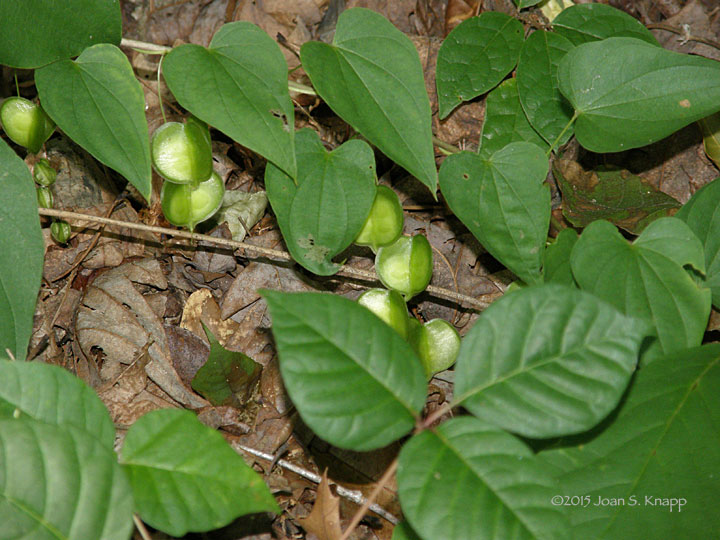
In the ‘Rock Garden,’ I found another Wild Yam (Dioscoria villosa) with quite a few seed capsules.


Nearby, Smooth Yellow False Foxglove (Aureolaria flava) plants were blooming.


The Resurrection Fern (Pleopeltis polypodioides) growing on the tree trunk a little further along the trail had dried up again.


The Perfoliate Bellwort (Uvularia perfoliata) still had its seed capsule.


Heading towards the bigger boulders.


The Resurrection Ferns on the boulders were still ‘alive.’ I guess they are more protected from drying in this spot.


I saw the first Indian Woodoats (Chasmanthium latifolium) of the season on this section of the trail.


I made my way off the Rock Garden trail and back onto the main trail over to the Old Fort.


I did have a goal for venturing out of the woods on this walk. When I drove in, I noticed the Swamp Rosemallow (Hibiscus moscheutos) blooming at the edge of the water. I always look forward to seeing these bloom.


One of many clusters of buds, and…


opened blooms to enjoy.


I noticed the first sprouts of Floating Primrose-Willow (Ludwigia peploides) for the season. These were covered with small insects.


I made my way back through the woods, past the Rock Garden trail, and…


along the main trail back to the Fishing Area. 

It’s always worthwhile to approach the bridge out of the Fishing Area cautiously. You’re never sure what you might spot from the bridge. On this walk, I spotted a…


Female Yellow-sided Skimmer (Libellula flavida), and a…


small Yellow-bellied Slider (Trachemys scripta scripta) that…


swam away when it realized it had been spotted.


The last spotting of the day were the seemingly ubiquitous Blue-fronted Dancers (Argia apicalis).

Related posts: